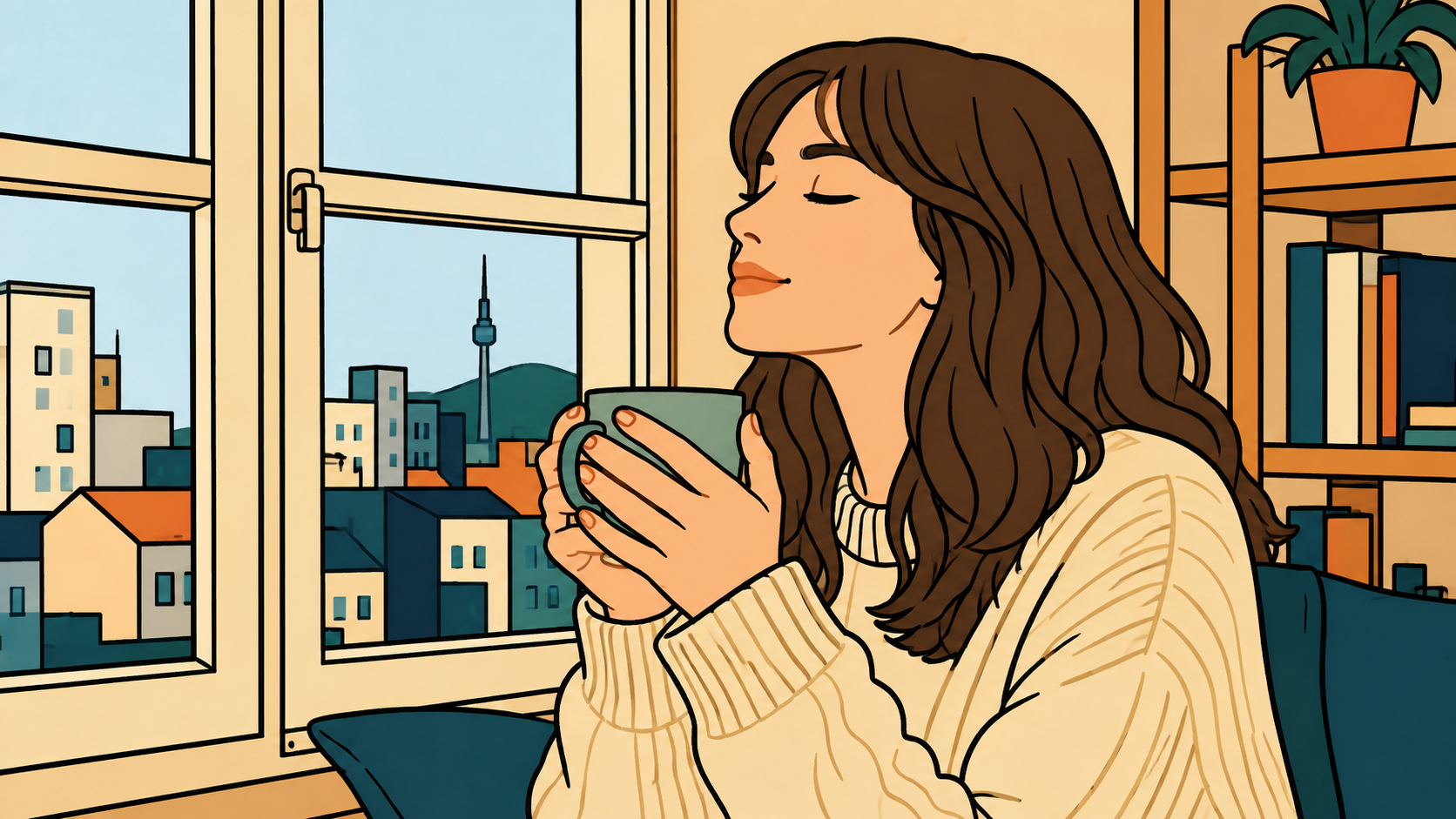

There’s a Tuesday in here somewhere with nothing to complete.
No deadline, no milestone, no distant thing to lean toward. Just a morning, a window, the sound of the kettle. For most of your reaching years, a day like this would have felt like a gap — dead time between the last push and the next one. But something’s different now, on the far side of arriving, and it takes you a while to notice what. Living in the present isn’t a technique you’re about to be sold. It’s what’s left when the reaching finally stops, and you look around at the ordinary hours you’d been treating as a waiting room.
A Day With Nothing to Complete
Start with what these days used to feel like.
Every ordinary hour used to be pointed somewhere. You drank your coffee on the way to something. You half-listened to a friend while a back channel in your mind worked the goal. The present was never quite where you lived; it was the corridor you walked through to get to the future where the real thing waited. Even rest was strategic — recovery for the next effort, never just rest.
So when the reaching stops, the first thing you feel isn’t peace. It’s the strangeness of an hour that isn’t pointed anywhere. A Tuesday with nothing to complete feels almost illegal, like you’re getting away with something, or like you’ve forgotten a task you can’t quite name. The unease is the residue of years spent treating now as a means. You have to sit in that discomfort a while before the next thing can happen.
And then, slowly, the hour stops feeling empty and starts feeling like an hour. The coffee has a taste. The light moves across the floor. Nothing is being accomplished, and for once that isn’t a problem to solve.
It helps to know the discomfort is temporary, and that it’s withdrawal, not emptiness. You spent years with your nervous system tuned to a signal — the pull of the next thing — and now the signal’s gone quiet. Of course the silence feels wrong at first. A body used to running toward something reads the absence of a target as a kind of alarm. But the alarm fades if you let it, and what replaces it isn’t boredom. It’s a slower, steadier register you’d forgotten you had.
Why Living in the Present Stops Feeling Like Waiting
The shift is small and it changes everything: the present stops being a corridor.
For years, the ordinary was the stuff between the milestones — the unremarkable middle you rushed through to get to the parts that counted. Meals, commutes, slow afternoons, the small talk of a normal week. All of it filed under not yet the real thing. You weren’t living those hours so much as processing them, waiting for the next arrival to redeem them.
Then the arrivals disappoint, one after another, and something in you stops believing they’ll redeem anything. That sounds like a loss, and at first it is. But there’s a quiet gift folded inside it. Once you stop waiting for the ordinary to turn into something else, the ordinary is finally allowed to just be what it is. The meal is a meal. The walk is a walk. The friend across the table is actually there, not a figure you’re half-attending while the future plays in your head.
This is living in the present, though the phrase is almost too grand for what it actually is. It’s not enlightenment. It’s just the end of treating your own life as a rehearsal for a performance that keeps getting postponed. The waiting stops, and what’s underneath the waiting turns out to have been your life the whole time.
You notice it first in the small refusals of your own restlessness. You sit through a whole cup of coffee without reaching for your phone. You walk somewhere without putting on a podcast to make the time productive. At first these feel like failures of ambition, like you’re slacking. Then they start to feel like something else — like permission. The afternoon doesn’t owe you a result. The walk doesn’t have to double as exercise or a thinking session. It can just be a walk, and you can just be someone taking it, and the strange discovery is that this was available all along. You didn’t need to earn it. You only needed to stop postponing it.
What You Notice When Nothing Is at Stake

When there’s no goal riding on the day, your attention changes hands.
For years your attention was owned — leased out to the goal, pointed wherever the reaching needed it. Now it comes back, and it lands on things it never had time for. The specific gray of the sky before rain. The way someone you love laughs at their own joke before the punchline. A song you’ve heard a hundred times revealing a line you never caught. None of it matters, in the sense you were trained to measure mattering. Nothing is at stake. And that turns out to be exactly why you can finally see it.
There’s a particular clarity to a moment with nothing riding on it. When you’re not scanning for advantage, not measuring the present against a future, the thing in front of you gets to be fully itself. You start to suspect that the richest parts of a life were never the summits at all. They were these — the unweighted moments you used to rush past on the way to something that felt more important, and never was.
It’s not that goals were the enemy. It’s that the reaching taught you to look through the present instead of at it, and you’re only now learning to reverse the lens.
And here’s the part that surprises people: living in the present isn’t something you have to work at, once the reaching loosens its grip. There’s no practice to master, no morning routine to install. The attention returns on its own the moment it’s no longer conscripted. That’s the quiet evidence that this was always your natural state — not a skill to acquire, but a capacity that was simply occupied, leased out to a future that kept not arriving. You’re not building something new. You’re getting something back.
The Life That Was Happening the Whole Time

Here’s the thing the whole climb kept you from seeing.
While you were reaching — heads-down, future-focused, sure that life would begin in earnest once you arrived — a life was quietly happening anyway. The ordinary Tuesdays accumulated. The people around you lived their days beside you. The seasons turned outside the window you were too busy to look out of. It didn’t wait for your permission or your attention. It just ran, in the background, unattended, while you kept your eyes on the far thing.
The arrival fallacy promised the good part was coming. What living in the present quietly reveals is that the good part wasn’t ahead. It was underneath — running the whole time, in the hours you discounted because they didn’t lead anywhere. They didn’t need to lead anywhere. That was never the point. You just couldn’t see it while you were moving too fast to look.
None of this arrives as a grand realization. It comes in small, almost forgettable moments — the first time a slow afternoon doesn’t make you restless, the first meal you taste all the way through, the first evening you don’t reach for your phone to fill the quiet. You could miss them entirely if you were still scanning for something bigger. They don’t announce themselves. They just accumulate, quietly, until one day the ordinary stops feeling like less.
You don’t have to stop having goals. The climb isn’t the mistake. The mistake was believing the view from the top was the only view worth having, when the whole time there was a window right next to you.
The kettle is boiling. The light is moving across the floor.
You’re here for this one.
This post was planned and edited by a human, with AI assistance.