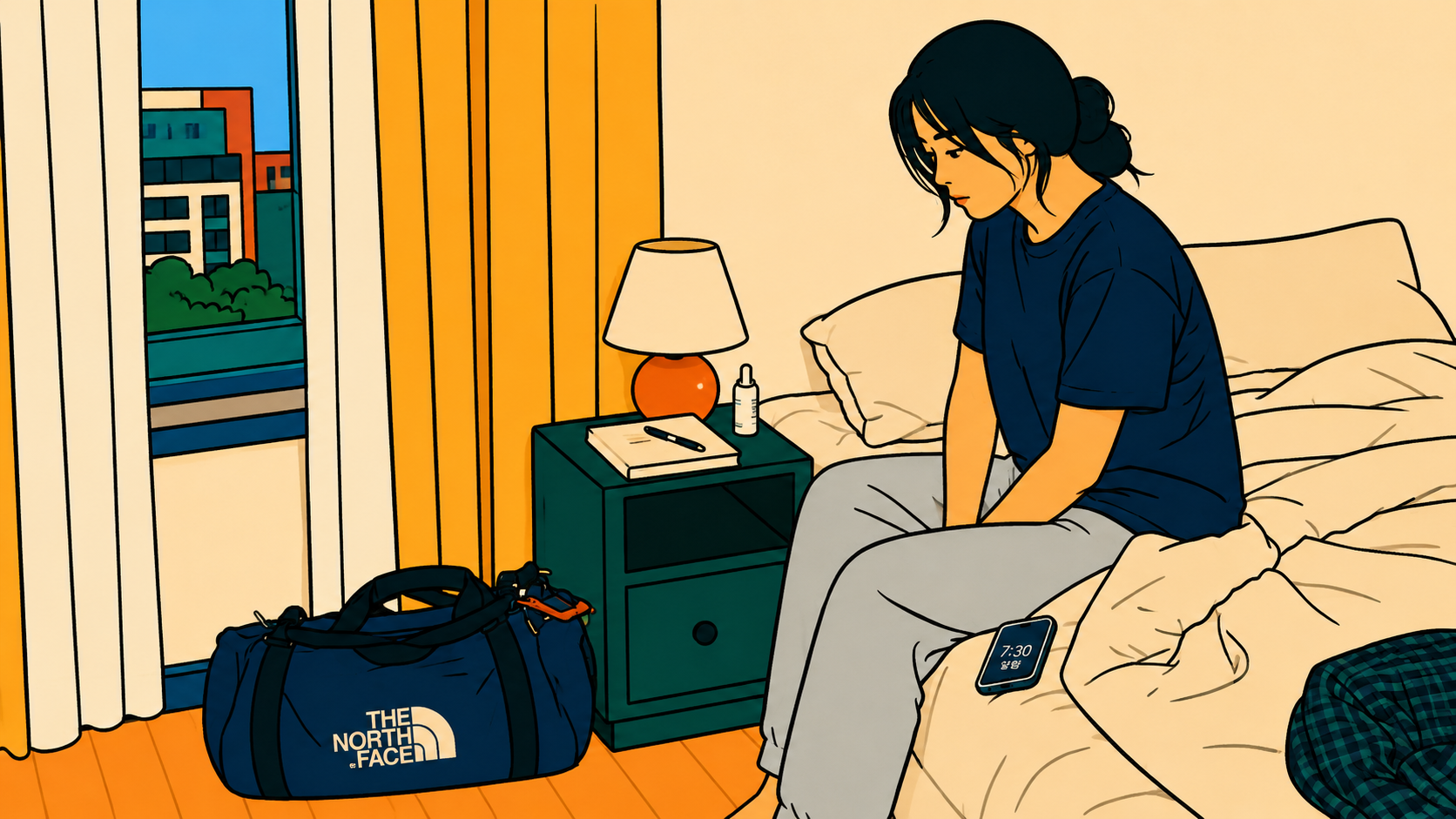

You know the one.
The 6 a.m. alarm. The gym bag already packed the night before. The journal on the nightstand. A year ago — maybe two — it worked. Not perfectly, but it held. You showed up. The results came. Something in your days felt organized around a spine.
Then something strange happened.
The alarm still rang. The journal was still there. The routine hadn’t changed. But it started feeling heavier. What once felt automatic now felt negotiable. You missed a day, then another, then enough days that the habit stopped feeling like a system and started feeling like evidence.
Evidence that you were slipping. Evidence that you were losing motivation. Evidence that the version of you who could do this was somehow gone.
But this is often why good habits stop working.
Not because the habit was wrong. Not because you became lazy. The habit was still fine. The conditions underneath it had changed, and you kept asking the same system to run on different ground.
The Habit That Used to Work
She kept a morning routine for eight months. Up at 6, journaling for twenty minutes, no phone until 9. She credited it with her most productive stretch in years.
Then she started a new role. The hours weren’t dramatically different. The commute was slightly longer. Nothing she’d call a crisis.
But the routine started slipping. She’d wake up and reach for her phone before she registered what she was doing. The journal stayed closed. By 9 a.m. she was already behind on something.
She assumed the problem was discipline.
It wasn’t. The new role required a different kind of mental load from the first hour of the day — reactive, relational, fast. Her old routine had been built for a different kind of morning. When the morning changed, the routine didn’t.
The habit didn’t fail. It became the wrong fit.
The harder part is that she’d built real identity around that routine. It wasn’t just a habit — it was evidence that she was someone who had her life together. Losing the routine felt like losing that proof. So she kept trying to revive it. Earlier alarm, stricter rules, a new journal. Each attempt lasted a few days before the same friction returned.
The routine wasn’t the problem. The conditions that had made it effortless no longer existed.
When Consistency Stops Producing Results

There’s a particular frustration in losing motivation for a habit you’re still technically doing.
You track the habit. You show up. You hit the streak. And somewhere in the middle of all that consistency, the results quietly disappear.
This is the version of the problem that self-improvement culture handles badly. The standard answer is: add more accountability, narrow the habit, make it smaller, attach it to a stronger cue. All reasonable. All occasionally useful.
But none of them ask the prior question: is this still the right habit for the conditions you’re currently in? This is exactly when good habits stop working — not from lack of effort, but from asking the wrong question.
Most people in this situation don’t have a habit problem. They have a timing problem dressed up as a discipline problem.
Time moves in cycles — not just seasons, but longer internal rhythms that shape how energy moves in a given period. What flows in one phase meets friction in another. Not because you changed your character, but because the ground shifted underneath you.
This isn’t abstract. It’s the same logic as seasonal farming. You don’t plant the same crop in every season and expect the same yield. The conditions determine what the action produces.
The Mistake Most Self-Improvement Advice Makes
Atomic Habits is one of the most useful books written about behavior change. The core argument holds: small actions, compounded consistently, produce large results — which is exactly how habit formation works in theory. The system matters more than the goal. Identity drives behavior more reliably than motivation.
All of that is true.
What it doesn’t fully account for is the variable underneath the system — the phase you’re in when you’re running it.
Most self-improvement advice is written as if the person is a constant and the habit is the only thing that needs optimizing. Add friction here. Remove friction there. Stack this habit onto that one.
The person is not a constant.
A consolidation phase — a period when energy contracts inward, when visible progress slows, when the right move is to hold rather than push — requires a different kind of routine than an expansion phase. Running expansion habits during a consolidation phase doesn’t produce expansion. It produces exhaustion.
The mistake isn’t the habit. It’s applying a phase-one strategy to a phase-two situation.
A lot of people arrive at this realization the hard way. They double down exactly when they should be letting a habit rest. They interpret the friction as a sign of weakness rather than a signal about timing. The habit survives — barely — but so does the exhaustion.
What Actually Changed

Think back to the last time a habit stopped working.
What changed in that period? Not just in the habit — in your life. A transition. A relationship shift. A role change. A loss. A move. Something that rearranged the structural conditions of your days, even subtly.
The habit didn’t change. The ground it was running on did.
This is worth staying with, because the first instinct when good habits stop working is to interrogate the habit — to look for what’s wrong with the system, the cue, the timing of execution. That’s useful, but it’s the second question.
The first question is: what changed in the conditions this habit was built for?
Seasons change. Phases shift. The version of you that built this routine was operating in a different set of circumstances — and that version made smart decisions for that context. The problem isn’t that you made bad decisions. The problem is that good decisions have expiration dates.
Some habits are built for expansion — they need momentum, outward energy, a certain kind of openness to new input. Others are built for consolidation — they need stillness, inward focus, less stimulation. When you’re in a consolidation phase and running expansion habits, the mismatch creates a specific kind of drag that feels personal but isn’t.
He tracked this pattern across two years without naming it. The networking calls, the morning runs, the weekly reviews — all habits that had produced results in his late twenties. At thirty-two, in a quieter stretch of his career, he kept every single one. The streak was intact. The results weren’t coming. He added more. A cold shower routine. A second journaling session. The drag got worse.
Nobody told him he was in a consolidation phase. Nobody told him that consolidation phases don’t reward output habits — they reward integration habits. He wasn’t failing. He was farming in the wrong season. The harvest wasn’t late. It was never going to come from that field.
Why Good Habits Stop Working
A habit is not a permanent solution. It’s a response to a specific set of conditions.
When those conditions hold, the habit works. When they shift, the habit starts to drag — not because it was ever wrong, but because it was always conditional.
The good news is that this reframes the problem entirely. You’re not broken, and you’re not really losing motivation. You don’t have a discipline problem. This is the real reason good habits stop working — not character, but timing. That’s a conditions problem. And conditions can be read.
Understanding your current phase changes how you read your own resistance. The drag you feel around a habit you used to love isn’t a verdict on your consistency. It’s information about where you are right now. And that’s worth more than any streak counter.
This is the question most habit systems don’t ask: not just what to build, but when to build it — and whether the conditions you’re in support what you’re trying to run. You can explore how that failure pattern operates structurally in The Failure Pattern Nobody Names.
The habit that worked last year may not be broken. It may simply be operating in a season it wasn’t built for.
That’s worth knowing before you decide to push harder.
This post was planned and edited by a human, with AI assistance.