
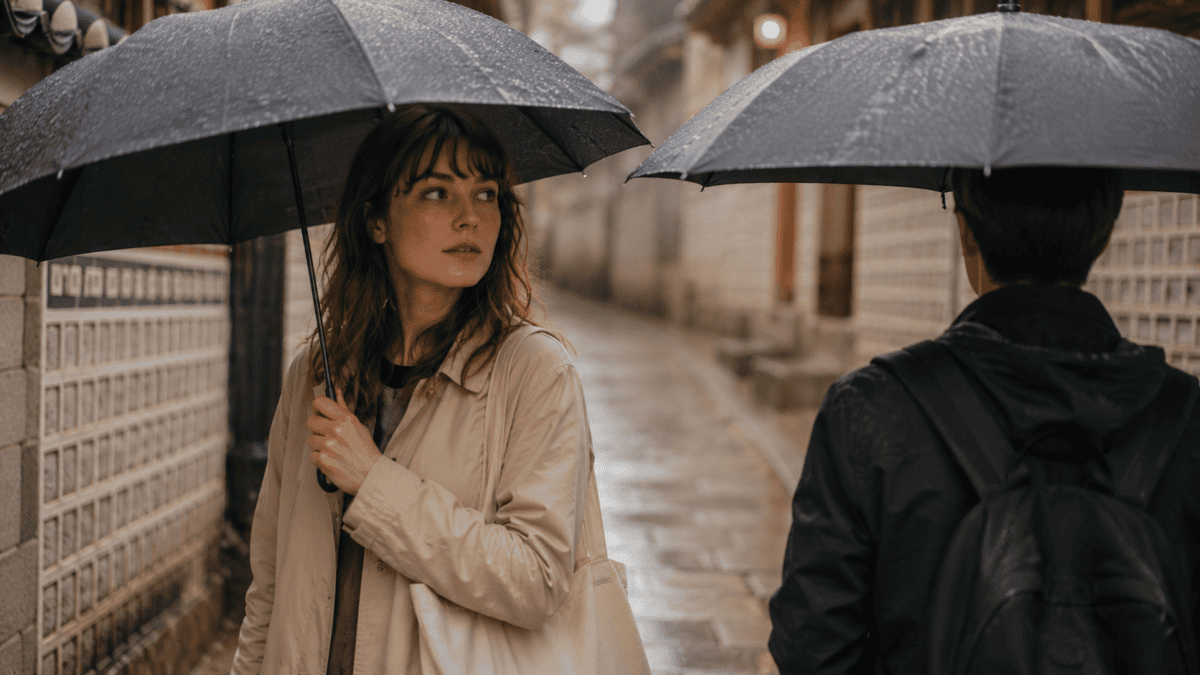
The rain season in Korea doesn’t work the way most Westerners expect rain to work.
When it rains in London, people pull up their hoods and keep walking. When it rains in Seattle, nobody really mentions it. When it rains in Seoul — something else happens entirely.
The drops have barely started. The pavement is still mostly dry. A Western visitor standing at a crosswalk might look up, register the light drizzle, and decide it doesn’t count yet. Not worth stopping for. Not worth the bag rummage.
But the people around her are already different. Umbrellas open in a single, quiet wave — not in response to heavy rain, but in response to something earlier than rain. A shift in air pressure. A particular weight in the humidity. Something that hasn’t fully arrived yet but is clearly on its way.
She watches this happen and feels, for a moment, like she missed a signal everyone else received.
She didn’t miss it. She just wasn’t trained to read it.
This is jangma (장마: jang-ma, the Korean monsoon season that descends each summer, typically from mid-June through late July) — not a storm to push through, but a seasonal rhythm the body has learned to anticipate. And the umbrella, open before the rain has committed to falling, is the first visible sign of how differently Korea and the West have learned to read the same sky.
The Rain Season in Korea Has No Default

In most Western cultures, rain carries a specific emotional grammar.
Plans get canceled. Moods dip. The instinct is to get inside as fast as possible, close the door, and wait it out. Even in cities famous for rain — London, Seattle, Amsterdam — the relationship tends to be one of tolerant resistance. You dress for it, you walk through it, you complain about it with the particular camaraderie of people enduring the same inconvenience.
The romanticized version of Western rain is almost entirely indoors. A window with drops running down it. A book. A wool blanket. Coffee going cold on the table. The rain exists outside; the warmth exists inside; the goal is to stay on the right side of the glass.
Rain makes people stay in. That’s the default.
Korea doesn’t run on that default. The rain season in Korea rewrites it.
A pojangmacha (포장마차: po-jang-ma-cha, a small street tent stall selling food and drinks, often open late into the night) with steam rising from the pot and the sound of drops hitting the plastic canopy. As the rain grows heavier, nobody rushes to leave. Another bottle appears, the plastic walls ripple softly in the wind, and the city outside begins to blur behind sheets of water. A bus stop where three people stand close together without speaking. A convenience store at the corner of a wet alley, its lights more yellow than usual against the gray.
In Korea, the rain doesn’t empty the streets. It changes the texture of everything happening in them.
A Language Built for Rain
One of the quietest signs of how deeply rain runs through Korean culture is in the language itself.
English has rain. Heavy rain. Light rain. Drizzle, if you’re being specific.
Korean has something else entirely.
Boseulbi (보슬비: bo-seul-bi, a soft, fine rain that falls gently without wind) is not the same as garangbi (가랑비: ga-rang-bi, a light but persistent drizzle that soaks without seeming to). Jangdaebi (장대비: jang-dae-bi, a heavy, rod-like downpour that falls in thick vertical sheets) is not the same as danbi (단비: dan-bi, a welcome rain that arrives after a long dry spell, the word carrying relief inside it).
English has words for rain too — drizzle, downpour, shower, torrential. But they measure it. How much, how hard, how fast. Korean words for rain don’t just measure. Danbi doesn’t describe how hard it’s falling. It describes how it feels to finally receive it.
Each word carries not just a description but a feeling — the specific texture of that particular rain, what it asks of you, what it means for the day. A language doesn’t develop this kind of vocabulary by accident. It develops it because, in a Korean rainy season, the distinction matters. Because the people speaking it have been paying close attention to rain for a very long time, and have decided that boseulbi and garangbi are not the same experience and shouldn’t be treated as one.
This is the same instinct as the umbrella that opens before the rain is fully rain. It’s a culture that reads weather in finer grain — not as a binary of raining or not raining, but as a continuous, shifting texture with its own specific qualities at each moment.
Not “it’s raining.” But which rain, exactly, and what does this one mean.
What Korean Dramas Already Know
There’s a recurring pattern in Korean film and television that Western viewers often notice without quite being able to name.
The rain scenes are quiet.
Not quiet as in calm — quiet as in empty of dialogue. Two people standing in the rain. Someone waiting at a bus stop while another person walks away. A figure standing outside a lit window, not going in. The camera holds. The rain falls. Nobody says anything.
In Western film, rain tends to be emotional punctuation — it arrives at the peak of the scene, underlines what’s already being said, amplifies the argument or the breakdown or the confession. The rain and the words happen together.
In Korean storytelling, the rain is the emotion. During the Korean rainy season, the words stop because the rain has taken over the job. The sound of it on pavement, on umbrellas, on the thin metal roof of a pojangmacha — that sound is already the scene.
In Korean dramas, rain doesn’t illustrate the feeling. Rain is the feeling.
This makes sense when you understand how Korea hears rain. Not as background weather, but as a sound environment with its own distinct vocabulary — the light percussion of boseulbi on leaves, the harder, more insistent rhythm of jangdaebi on pavement, the specific sound of water falling from a traditional roof’s overhanging eave in a single, heavy thread.
A Korean audience hears those sounds in a scene and already knows what kind of moment this is. The silence isn’t emptiness. It’s precision.
The Distance Rain Makes Visible
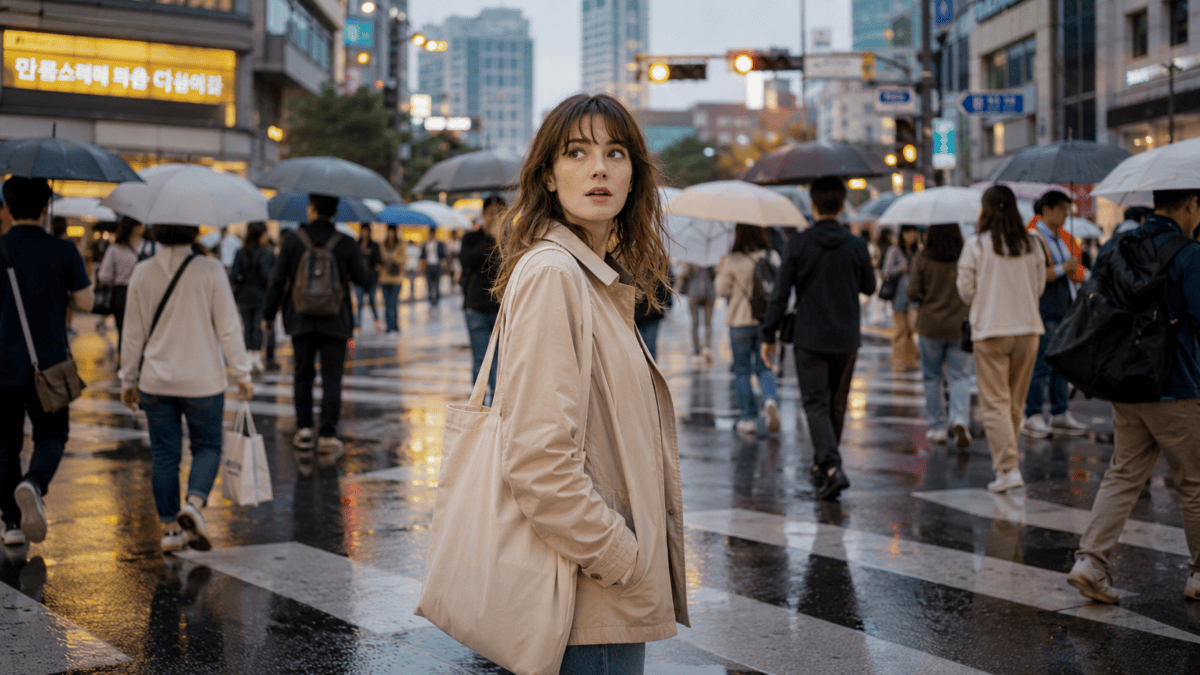
Western rain falls on one person. Korean rain falls between people.
In Western storytelling, rain mirrors individual emotion. The character is sad; it rains. The character is overwhelmed; the storm arrives. The rain belongs to whoever is standing in it.
In Korean culture, rain is more often about the space between people — and what that space does or doesn’t close.
The distance between two umbrellas on a narrow street. Whether someone offers to share theirs, and whether the offer is accepted. Someone standing in the rain without an umbrella, refusing to step under the shelter being held out to them. A person who drives across the city to pick someone up, and doesn’t explain why. Someone who waits at a bus stop after the last bus has gone.
These are small actions. On a clear afternoon, they would pass unnoticed. But during the Korean rainy season, even the gap between two umbrellas carries weight. The rain makes these distances legible — a kind of pressure that reveals what was already there.
Pajeon (파전: pa-jeon, a Korean savory pancake made with green onions) appears in these scenes too. Not as food exactly, but as the thing that creates the table — the reason two people are sitting across from each other, close enough to share a plate, with rain making it difficult to be anywhere else.
The meal doesn’t fix anything. The shared umbrella doesn’t resolve anything. But both of them change the geometry of the moment — how close two people are standing, what they can hear over the rain, whether there’s a reason to stay a little longer.
Where Western cultures read rain as interruption, Korean sensibility reads it as a shift in direction — what some call inward and outward forces at work in the season itself. The rain doesn’t create these distances and hesitations. It simply makes them visible.
Rain doesn’t make Koreans stay inside. It changes how they move around each other.
This post was planned and edited by a human, with AI assistance.