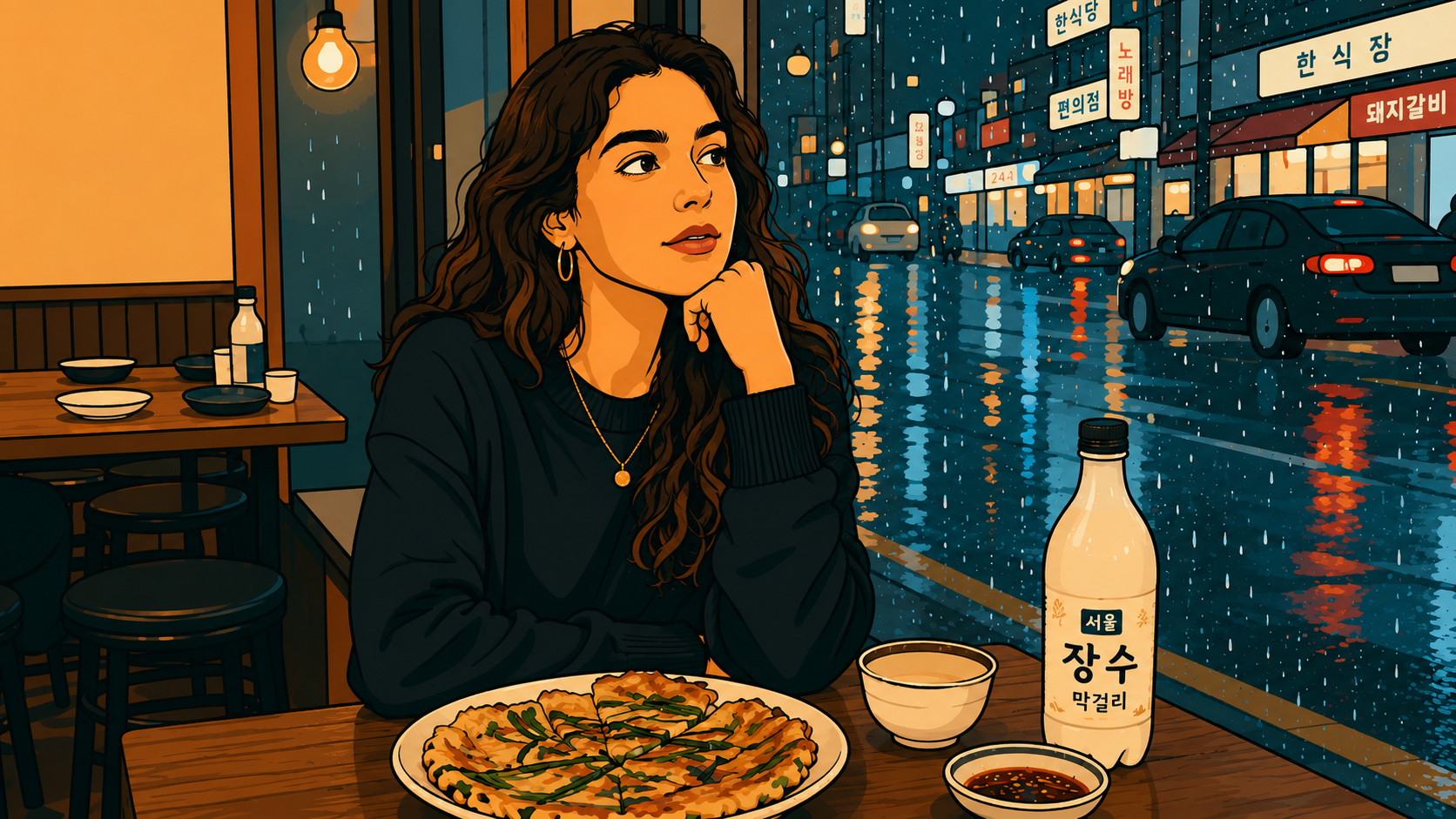

There’s a specific kind of afternoon that only exists during the Korean rainy season.
The rain has been falling since morning. Not dramatically — just steadily, the way jangma rain tends to fall, without urgency, without any sign of stopping. The street outside is wet and quiet. Somewhere nearby, someone is frying something. The smell reaches you before the sound does.
You weren’t planning to stop. But then the smell hits, and you do.
This is how pajeon finds you.
The Meal the Rain Orders for You

Pajeon (파전: pa-jeon, a Korean savory pancake made with green onions, pan-fried until the edges crisp) doesn’t need to be explained to most people who’ve spent time in Korea during the rainy season. They already know it. Not from a recipe — from a specific afternoon when the rain was falling and someone put a plate down in front of them and everything made sense.
The pairing with makgeolli (막걸리: mak-geo-lli, a milky, lightly fizzy rice wine with a low alcohol content and a slightly sour finish) is so established that it doesn’t need explaining. Every Korean who hears rain during jangma has, at some point, already thought about pajeon. Not because anyone told them to. Because the sound of rain on a roof and the sound of something frying in oil are closer than they should be.
What the rain is actually doing here isn’t creating hunger. It’s creating permission.
Permission to stop. To sit. To order something that takes time to eat. To stay at the table longer than necessary. In a culture that otherwise moves fast — Seoul is not a slow city — jangma is one of the few seasons that asks people to decelerate, and pajeon is what you eat while you do it.
The meal doesn’t require conversation. Two people can sit across a plate of pajeon in the rain and not say much, and it doesn’t feel like silence. It feels like the right amount of words for this kind of afternoon.
What the Convenience Store Knows

If pajeon is the rain meal you sit down for, the Korean convenience store is the rain meal you didn’t plan.
CU, GS25, 7-Eleven — they’re everywhere in Seoul, lit from the inside with that particular yellow-white light that looks warmer when the street outside is gray and wet. During the Korean rainy season, the convenience store becomes something slightly different from what it usually is. Not just a place to grab something quickly. A place to pause.
The ramen counter. The small plastic stools just inside the door. The couple sharing a paper cup of something hot, not quite ready to go back out. The woman standing under the awning, eating tteokbokki (떡볶이: tteok-bo-kki, chewy rice cakes in a spicy-sweet sauce) from a paper tray, watching the rain without any particular expression.
Nobody is waiting for the rain to stop. They’re just — here. For a moment. Using the rain as a reason to be somewhere without needing a better reason.
This is something Korea does well: making a pause feel like enough.
The selection matters too. A Korean convenience store during jangma stocks things that only make sense in rain: small folding umbrellas near the entrance, hand warmers in July because the air conditioning runs cold, ramyeon flavors that don’t exist outside Korea. The shelves are organized around what a person standing in the rain might actually need next — not what they planned to need, but what the rain decided for them.
Western cities have coffee shops for this. But a coffee shop implies a certain kind of lingering — you need a drink, a seat, possibly a laptop. The Korean convenience store in the rain asks for nothing. You can stand there for four minutes eating something warm and then leave, and nobody finds it strange.
The rain made you stop. The convenience store just held the door open.
The Sound the Rain Makes Inside
There’s a particular quality to being indoors during jangma that doesn’t translate well in English.
It’s not cozy, exactly. Cozy implies candles and blankets and a deliberate arrangement of comfort. This is different — quieter, more accidental. The rain outside makes the inside feel more interior. More specific. Like the walls have moved slightly closer, not in an uncomfortable way, but in the way that makes a room feel more like a room.
In older Korean homes, the sound of rain changes depending on where it’s falling. On the wooden floor of a maru (마루: ma-ru, the raised wooden floor of a traditional Korean house, open to the courtyard). On the clay tiles of a roof. Through the narrow gap between buildings in a city alley. Each surface returns a different sound, and the sounds layer.
Modern apartments don’t have this. But they have the rain on windows. On air conditioning units. On the thin metal awnings above convenience stores. Korean rain finds surfaces everywhere, and each surface answers differently.
A person who has spent jangma in a Seoul apartment knows the specific rhythm of rain on a narrow aluminum window frame. The way it shifts when the wind picks up. The brief silence before a heavier wave arrives. You start to track it without meaning to — the way you might track a conversation happening in the next room, not listening exactly, but aware.
Someone on the other side of a thin wall is watching something on their phone. The audio bleeds through, then stops. Outside, a scooter passes without slowing down. Then just the rain again, recalibrating.
Nobody planned to spend the afternoon like this. But here they are — two people in separate rooms, listening to the same rain.
The silence isn’t empty. It’s already occupied.
Outside, the rain keeps finding new surfaces. A plastic bag caught on a railing. The lid of someone’s recycling bin. A forgotten umbrella leaning against a wall. Each one answers differently. None of them were asked.
What the Korean Rainy Season Leaves Behind
Here is something that doesn’t get said enough about the Korean rainy season: it gives people an excuse to do less.
Korea operates at a pace that can be difficult to opt out of. The expectation to be productive, to be social, to be somewhere — it runs underneath daily life even when nobody is saying it out loud. Jangma interrupts this. Not dramatically. Not with a snow day announcement or a cancelled plan. Just — the rain is falling. The streets are wet. Something about today is slower.
Plans don’t get cancelled. They get softer.
A friend says she’ll be a little late. The group chat goes quiet for a few hours. Someone who was supposed to come over suggests staying in instead. Nobody explains why. Nobody needs to. The rain is explanation enough.
For a Western woman encountering jangma in Seoul for the first time, this can feel disorienting and then, suddenly, like relief. The permission to slow down isn’t something she asked for. It arrived with the rain. And unlike the permission she might give herself back home — which usually comes with conditions, with guilt, with a plan to make up for it later — this one comes without negotiation.
The rain decided. A woman checks her phone, sees the message — running late, sorry — and puts it face-down without replying. Not because she’s annoyed. Because she’s already doing the same thing. For a culture that understands the season asks you to receive before it asks you to move, jangma isn’t a pause. It’s the point.
It doesn’t leave you with highlight reel memories either.
Rain on plastic. The smell of something frying. A street so wet it stopped looking like a street.
These don’t make it into photos. But they don’t leave either.
That’s the Korea jangma shows you. Not the one you planned to see.
This post was planned and edited by a human, with AI assistance.