

There’s a specific kind of message that only gets sent during the jangma (장마: jang-ma) season.
Not a long one. Not one that requires a reply. Just — it’s raining here too. Or a photo of a window with drops on it, sent without context. Or nothing at all, just the awareness that someone, somewhere, is also listening to the same kind of rain and probably thinking about the same kinds of things.
The rainy season does this. It narrows the world down to a smaller radius. And inside that radius, certain people become more present — not because anything happened, but because the rain arrived and rearranged the furniture.
What the Jangma Season Does to Distance
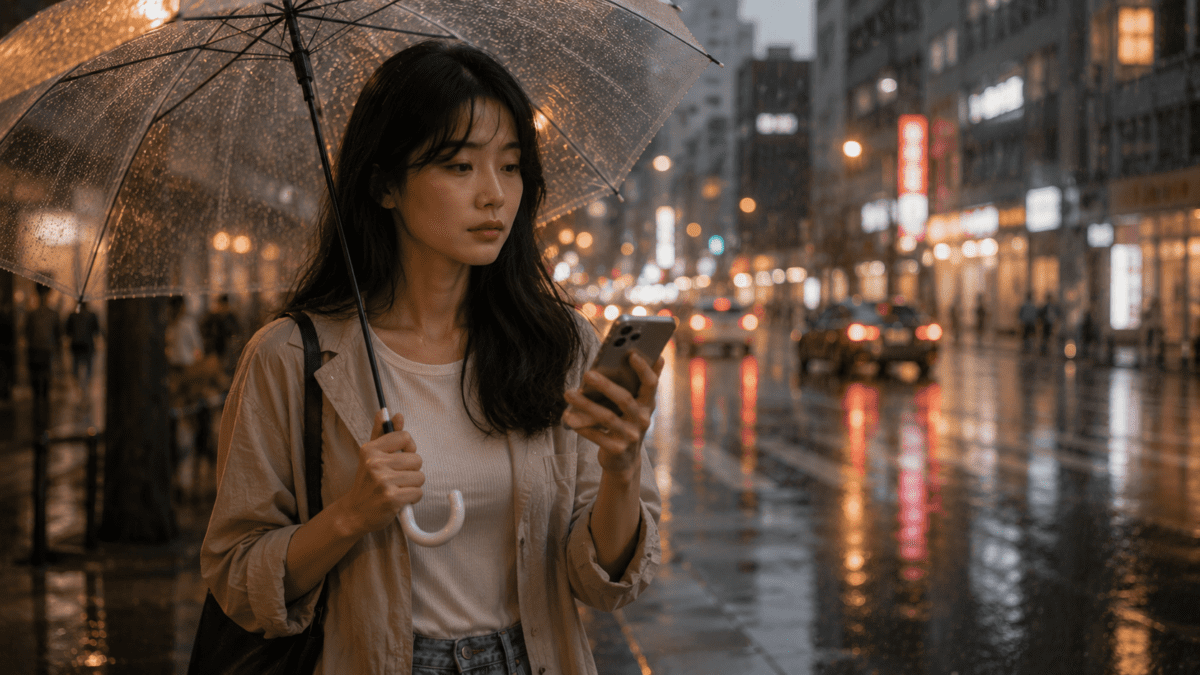
Everyone has someone they think about when it rains.
Not always a romantic person. Sometimes a friend who moved away. Sometimes a version of yourself from three years ago, sitting in a different city, listening to rain on a different roof. Sometimes a person you haven’t spoken to in a long time, and the rain makes the silence between you feel both longer and more tolerable at the same time.
In Korea, this particular experience has its own grammar. The jangma season doesn’t just bring rain — it brings a specific social softness. The kind where it becomes acceptable to reach out to someone you’ve been meaning to reach out to, because the rain gives you a reason that doesn’t need to be explained.
The rain is an excuse. But it’s also not an excuse. Both things are true.
A Korean drama will show you this in a single shot: a character staring at a phone, rain against the window, thumb hovering over a name. The scene doesn’t need dialogue. The audience already knows what’s happening. They’ve been there. The rain made them think of someone. The question is always whether they sent the message.
Most people don’t. The rain passes. The moment closes.
What’s interesting isn’t whether the message gets sent. It’s that the rainy season created the conditions for it to almost exist. A relationship that spent months operating at a comfortable distance suddenly has weather. Not a problem, not a resolution — just weather. The kind that makes you aware of where you’re standing.
This is also when the quietly submerged people surface. The friend you had a falling out with two years ago, whose last message you never answered. The person you dated briefly who always ordered the same thing at the same restaurant you’re now sitting in alone. The family member who called last month and you said you’d call back.
None of these are dramatic. That’s the point. Jangma doesn’t bring back the people associated with big, loud memories. It brings back the ones attached to small, specific textures — the sound of someone’s laugh in a particular kind of room, the way someone always carried their umbrella slightly wrong, a shared joke about a restaurant that no longer exists.
These aren’t people you’re necessarily supposed to contact. Sometimes the surfacing is enough. The rain brought them up. You held them for a moment. Then the rain moved on, and so did you.
Korea understands this. There’s no pressure to act on what the rain surfaces.
The pojangmacha (포장마차: po-jang-ma-cha, a small street tent stall selling food and drinks, often open late into the night) owner who refills your cup without asking isn’t wondering about your inner life. The couple at the next table isn’t paying attention to the fact that you’ve been staring at your phone for ten minutes without opening it. The rain has given everyone permission to be somewhere private in public — and in Seoul, during this season, that permission extends to whoever you’re thinking about. The city is dense enough that you’re never truly alone, but when jangma arrives, the density becomes privacy. Everyone is occupied with their own interior weather. Nobody is watching.
The Particular Loneliness
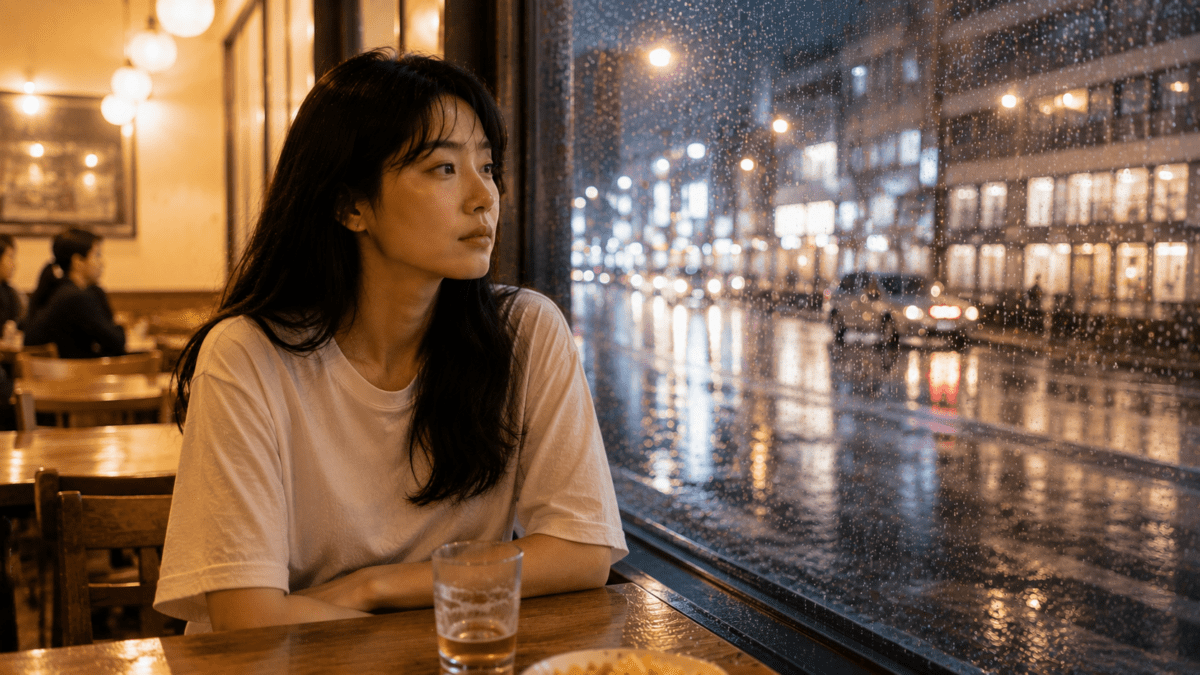
There’s a word in Korean that doesn’t translate cleanly into English.
Gwaenchanh-a (괜찮아: gwaen-cha-na) means something like “it’s okay” or “I’m fine” — but it’s used in a way that English doesn’t quite allow. It can mean fine when things aren’t fine. It can be an answer to a question that wasn’t asked. It can be said to yourself, quietly, while watching rain fall on a street where nobody you know is walking.
During the jangma season, gwaenchana gets used a lot.
Not because people are suffering. But because the rain creates a particular kind of interior weather — not sadness exactly, not longing exactly, but something adjacent to both. A heightened awareness of where you are and who you’re with and who you’re not with. A quiet inventory of the distances in your life.
This isn’t melancholy. It’s more like honesty.
A Western framework tends to pathologize this kind of feeling — to treat it as something to fix, to move through, to resolve with action. Book a flight. Text someone. Do something. This season offers a different suggestion: stay where you are. Let the rain do what it’s doing. The inventory doesn’t need to become a to-do list.
This is harder than it sounds for people who weren’t raised inside this rhythm. The instinct to respond, to resolve, to convert feeling into action — it’s deeply ingrained. Sitting with something unresolved, not because you’re avoiding it but because the season is asking you to, requires a different relationship with time. Korea has had centuries to develop that relationship. The rainy season is one of the places it shows most clearly.
There’s also a specific acoustics problem that arrives with the rain. Silence, during jangma, is never quite silent. The rain fills the space — landing on the window, on the air conditioning unit, on the plastic lid of the recycling bin someone left outside. Each surface answers differently, and the answer keeps changing as the rain shifts weight and direction.
This is fine when you’re not thinking about anyone in particular. It becomes complicated when you are.
The sound of rain in a room where someone used to be is different from the sound of rain in a room where they never were. Memory attaches to sensory detail, and this season is full of sensory detail. The smell of wet pavement. The particular grey of a Seoul afternoon in July. The way voices carry differently when the street is empty and wet.
A person who has been through jangma in Korea more than once starts to accumulate these. Specific rainy afternoons that don’t have names but have textures. A specific restaurant. A specific window. A specific version of the city that only appeared for a few weeks and then was gone until next year.
These aren’t losses. They’re just what the rain leaves in the room when it goes.
What Jangma Asks of You
Here is what this season asks, if you let it:
Sit with it for a while.
Not the sadness — there may not be sadness. Not the longing — there may not be longing. Just the awareness. The specific, quiet awareness of your own life as it currently is: who’s in it, who’s drifted, who you’ve been meaning to call, who you’re glad you didn’t.
The rain doesn’t judge any of this. It’s not asking you to do anything about it. It’s just making the interior visible for a few weeks, the way it makes the streets visible — everything wet and reflective and slightly more honest than usual.
In Korean culture, there’s an understanding that some seasons are for receiving rather than producing. Not every period of quiet is a problem to solve. For a culture that understands the season asks you to receive before it asks you to move, the jangma season isn’t a gap between more important things.
The message you almost sent. The person you held in mind for ten minutes over a cup of makgeolli (막걸리: mak-geo-lli, a milky, lightly fizzy rice wine with a low alcohol content and a slightly sour finish). The silence you didn’t try to fill. These aren’t failures of action. They’re the rain doing what it does — making the distances in your life briefly, clearly visible, without requiring you to change them.
Most things the rain surfaces don’t need to be resolved. They need to be seen. This season gives you the conditions to see them, and then — characteristically — asks nothing further.
After the Rain
The jangma season ends the way it begins — not dramatically.
One morning the air is different. Lighter. The streets dry faster. The pojangmacha that was open every night starts closing earlier. The umbrella by the door gets moved to the back of the closet.
The people the rain surfaced go back under. Not gone — just quieter. The message you almost sent is still there in your drafts, or not there at all because you deleted it, or somewhere in the middle because you typed half of it and then the rain stopped and the moment passed.
Seoul moves fast again. The permission lifts. The inventory closes.
And yet — something stays in the room. A name you hadn’t thought about in a long time. A restaurant you’ll go back to when it rains next year. A version of the city you didn’t know existed until the streets were wet enough to reflect it back.
The rain showed you something. A person, a distance, a silence you’d been carrying without knowing its weight. Whether you do anything with it is a separate question entirely.
Jangma doesn’t push. It just makes things visible — and then moves on, leaving the rest to you.
This post was planned and edited by a human, with AI assistance.