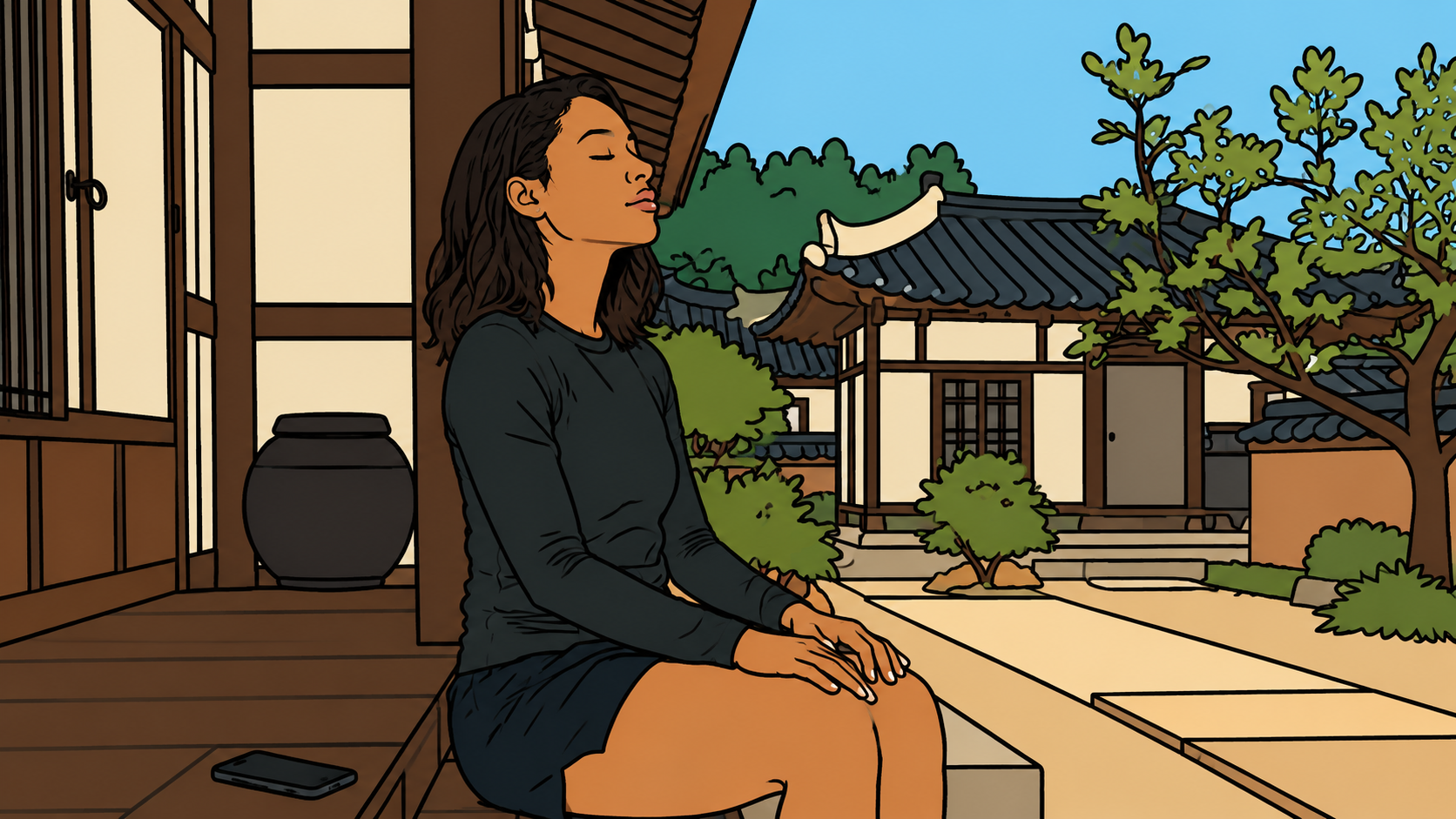

You’ve been moving your entire life. The checking, the earning, the proving—all of it motion. All of it the sound of someone running from something. And the exhaustion itself is telling you something that nobody says out loud: what if stopping is not failure, but the moment when a different kind of stability actually begins?
This is the question that sits underneath everything. Not “how do I run faster?” but “what if I don’t have to run at all?” Not “how do I prove more?” but “what if I’m already safe without constant evidence?” The unconditional safety your nervous system never learned to trust may already be closer than you think, if you can tolerate the terror of stopping long enough to notice it.
The pattern didn’t start with motion. It started with the message: stop and you disappear. So you learned to run. And now, after decades of running, your nervous system is so tired it’s asking the same question in the only language it knows—through the exhaustion itself.
The Exhaustion as Information
Your exhaustion is not a personal failing. It’s not weakness or laziness or lack of discipline. It’s information. Your nervous system is trying to tell you something that decades of motion have drowned out: the system it built to keep you safe is no longer serving you. The goalpost shifting, the endless proving, the checking that never stops—these are not helping anymore. They’re just exhausting.
This is the hardest part to understand, because exhaustion has been reframed in your life as something to push through. Rest is laziness. Stopping is failure. Slowing down is proof that you’re not doing enough. So you interpret the exhaustion not as a signal to change direction, but as evidence that you need to run harder.
But what if the exhaustion is actually the first opening? What if your nervous system getting tired is the moment it finally becomes willing to try something different?
The stability you’re looking for doesn’t require more speed. It requires stillness long enough to recognize that you’re already here. That you made it. That the threat your nervous system has been running from for decades doesn’t actually have the power it thinks it does. And when you finally stop moving long enough to see that, something shifts. Not because you did something right. But because you stopped doing the wrong thing.
This is what the exhaustion is trying to tell you: the system is exhausted, not you. And there’s a difference.
What Happens When You Actually Stop

Stillness feels terrifying. Not because stopping is dangerous, but because your entire operating system was built on the premise that stopping equals disappearance. When you slow down, when you rest, when you stop checking—your nervous system reads that as the exact moment the threat it’s been protecting you from will strike.
This is why rest feels like irresponsibility. Why taking your foot off the gas feels like losing control. Why unconditional safety—the idea that you could be safe without constantly proving it—feels impossible.
But here’s what happens when you stop long enough to notice: nothing catastrophic occurs. The checking stops. The money is still there. You’re still breathing. The people who matter to you still matter. Life continues, exactly as it was, except that you’re no longer running from it.
And in that continuation, something becomes visible that motion had been obscuring: the safety that was already there. Not conditional on your next achievement. Not dependent on the next proof. Just there. Available. Present.
Real safety is not something you build through effort. It’s something you recognize through stopping. Your nervous system learned a long time ago that safety was conditional. But that learning happened in a specific context, under specific conditions, by a nervous system that was much younger and had much fewer resources. The threat it learned to fear was real in that moment. The survival strategy it built made sense.
But you’re not in that moment anymore. You’re not that young. You’re not that vulnerable. And the conditions have changed, even if your nervous system hasn’t updated its threat assessment.
What becomes possible when you finally stop running long enough to let your nervous system update? When you show it, again and again, that safety doesn’t require constant proof? That you can rest and the world doesn’t end? That unconditional safety is not a luxury you have to earn—it’s a baseline you can finally trust?
The Proof Your Nervous System Actually Needs
For decades, your nervous system has been looking for proof in the wrong places. It’s been looking for numbers—in the account, in the achievements, in the recognition. It’s been looking for external validation that it’s safe to exist. And every number, no matter how large, has been insufficient. Because the proof it was actually looking for was never a number at all.
What your nervous system actually needs is this: that you can tolerate the uncertainty of not knowing. That you can live with ambiguity. That you can stop checking and still be okay. That safety is not a state you have to defend against loss—it’s a state you can inhabit simply by being here.
This is not the kind of proof that comes from doing more. It comes from doing less. From the accumulating evidence, over time and through repeated experience, that stopping doesn’t cause catastrophe. That rest doesn’t lead to disappearance. That safety was never as conditional as your nervous system learned to believe.
Your nervous system will test this. It will send you signals that you need to check your balance. That you need to keep moving. That rest is dangerous. And each time you tolerate the discomfort of not checking, each time you rest without catastrophe, each time you move through the day without proof—you’re providing your nervous system with the exact data it needs to update its threat assessment.
This is how patterns change. Not through willpower. Not through logic. But through the accumulated, embodied experience of safety that doesn’t need to be earned.
When Unconditional Safety Starts Feeling Real

When you stop running, something unexpected happens. The relationship between you and your own exhaustion changes. You’re no longer at war with yourself. You’re no longer trying to outrun the thing that’s trying to catch you. The conflict that kept the system running begins to quiet.
And from that place—where you’re not divided against yourself, where the exhaustion becomes information instead of evidence of failure—the pattern begins to shift. Not all at once. Not in a way that feels dramatic. But in the quiet, persistent way that patterns change when the nervous system finally gets the message it’s been waiting decades to receive.
The checking might still happen. Your anxiety might still rise. The conditional beliefs your nervous system learned might still activate. But you’ll be able to see them differently. Not as truths, but as old operating instructions that no longer serve you. Not as proof that you’re failing, but as evidence of how hard your nervous system has been trying to keep you safe.
And there’s a kind of compassion that becomes possible when you see it that way. Not the forced, performative self-love that never quite works. But the natural compassion that comes from understanding: this pattern wasn’t chosen. It was assembled. And now that you see it, it can be reassembled differently.
This is the moment when safety stops being an idea and starts feeling real. Not because you earned it or proved you deserve it. But because you finally stopped long enough to recognize that it was always there. That you were always safe. That the threat your nervous system was running from had power only as long as you kept running.
What becomes possible when that recognition lands?
This post was planned and edited by a human, with AI assistance.