The gem doesn’t cut. It reveals.
Sin (신: sin, yin metal, the gem) is not a blade. Where Gyeong (경: gyeong, yang metal, the blade) removes what doesn’t belong in a single decisive cut, Sin works differently — through sustained pressure, precise friction, and time. The surface becomes exact not because something was taken away in one motion, but because the refinement never stopped. What emerges is not what was added. It is what was always inside, made visible by the process.
The yin metal stem in K-Saju is the eighth Heavenly Stem and the yin expression of Metal (금: geum). In K-Saju, Metal governs structure, refinement, and boundary. In its yin form, that refinement is continuous and internal. Sin doesn’t establish the boundary by removing what’s outside it. Sin finds the boundary by polishing until the essential structure surfaces from within.
The Surface That Never Stops
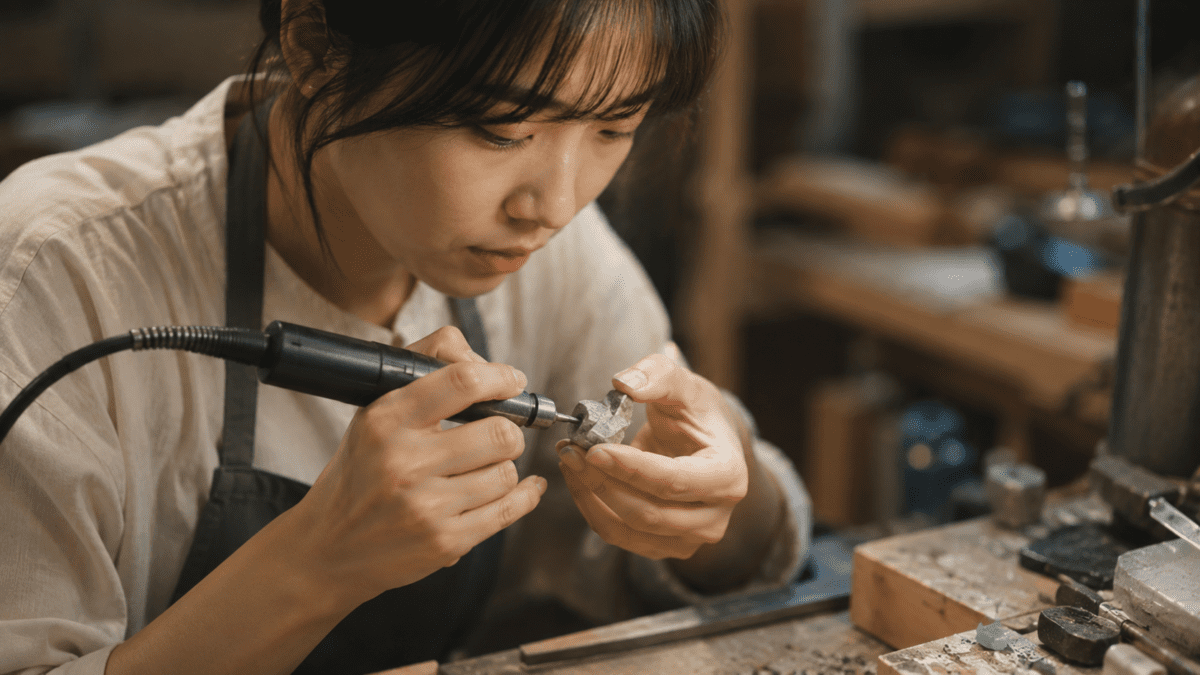
Sin (yin metal, the gem) operates on a principle that distinguishes it from every other Metal stem and from most yin stems: refinement as a continuous process rather than a decisive event. Gyeong (yang metal, the blade) produces definition through a single cut — the line is established, the non-essential is removed, the structure that remains is more exact. Sin produces definition differently. The gem doesn’t arrive at precision through removal. It arrives through sustained contact with what it’s refining, applied consistently, until the surface reveals what was always underneath.
In K-Saju, Sin is the yin expression of Metal (금: geum). Yin and yang within the same element are not opposites — they are the same energy expressed through different mechanisms. Both Gyeong and Sin govern structure, refinement, and boundary. But where Gyeong’s refinement is external and decisive — it cuts away what doesn’t belong — Sin’s refinement is internal and continuous. The gem doesn’t remove the impurities. It works the surface until the impurities become indistinguishable from the clarity surrounding them, or until the pressure reveals a fault line that defines the boundary more precisely than any cut could.
The mechanism is specific. Sin doesn’t operate on the whole structure at once — it operates on the point of contact between the polishing surface and the gem. The pressure is sustained, the movement is precise, and the output is cumulative. What looks like nothing is happening on the surface is the refinement in process. The gem is being worked. The clarity is building. The moment it surfaces is not the moment the work began — it’s the moment the work finally became visible.
The contrast with Gyeong (yang metal, the blade) sharpens what makes Sin’s mechanism distinct. Gyeong produces immediate, visible results — the cut is made, the structure changes, the output is clear. Sin produces results that are invisible until they aren’t. A Gyeong chart reads as decisive. A Sin chart reads as still — right up until the moment the surface clears and what was always inside becomes the most precise thing in the room.
In the chart, a Sin Day Stem (일간: il-gan, primary stem) identifies a person whose primary operating mode is sustained refinement that produces precision over time. They are not the person who cuts through the problem, radiates the solution, or holds the center while others work. They are the person whose output looks like nothing is happening — until the surface clears. The influence is not visible in the moment of work. It is visible in the quality of what the work eventually reveals.
What this means for the reading is significant. Sin charts are chronically underread because the refinement is invisible. The process looks like stillness. But the gem is being worked. The reading needs to assess not what is visible — the surface rarely shows the work in progress — but what the sustained pressure is building toward, and whether the conditions around the Sin stem are providing the right friction to bring the clarity to the surface.
Sin doesn’t cut to reveal. It refines until what was always there becomes impossible to miss.
Four Ways the Refinement Process Fails to Produce Clarity

Sin (yin metal, the gem)’s failure is not stopping — it is the refinement continuing when the conditions can no longer bring the clarity to the surface.
The pattern looks like this: Sin has been working. The sustained pressure has been applied consistently — the polishing hasn’t stopped, the contact has been maintained, the process has been running exactly as designed. But the surface isn’t clearing. The clarity that should be building isn’t surfacing. The gem is being worked. The work isn’t producing what the work is supposed to produce. From outside, this looks like nothing is happening. From inside, the mechanism is running at full capacity with nothing to show for it.
This is Sin’s primary failure pattern: sustained refinement that produces no visible clarity.
The second pattern is surface damage. Sin (yin metal, the gem) refines through sustained pressure and precise friction. The mechanism requires calibration — the right amount of pressure applied at the right angle produces clarity. Too much pressure, or pressure applied at the wrong angle, doesn’t produce more clarity.
It produces surface damage. The gem is being worked harder than the structure can absorb. What should be refinement becomes abrasion. The surface becomes less exact, not more. A Sin chart running through a Daewoon (대운: dae-woon, ten-year cycle) that amplifies the pressure beyond what the structure can sustain produces this pattern — the refinement mechanism is intact, the pressure is wrong, and the output is deterioration rather than clarity.
The third pattern is elemental. Fire melts Metal in the controlling cycle (상극: sang-geuk, mutual constraint) — Byeong (병: byeong, yang fire, the sun) or Jeong (정: jeong, yin fire, the candle) in dominant positions exerts direct controlling pressure on Sin. For Gyeong (yang metal, the blade), Fire constraint compromises the edge. For Sin (yin metal, the gem), Fire constraint is different: the sustained pressure that produces refinement becomes inconsistent. The polishing doesn’t stop — but it loses its precision. The friction is no longer calibrated. What was building toward clarity begins to drift. The gem is still being worked. The work is no longer exact.
The fourth pattern is the absence of Earth. Earth generates Metal in the generative cycle (상생: sang-saeng, mutual nourishment) — Mu (무: mu, yang earth, the mountain) or Gi (기: gi, yin earth, the field) supplying the source material from below. Without Earth support, Sin refines through whatever structural resources the chart carries. The precision is still there. The sustained pressure is still applied. But the material being refined is being consumed faster than it can be replenished. The gem is getting smaller as the clarity builds. There will be a point where there is nothing left to refine.
All four patterns converge on the same structural fact: the refinement is still running. What varies is whether the surface can absorb it, the calibration is holding, or the material is still there. Sin is still working, still applying pressure, still refining. The problem is not the process. The problem is refinement without output, pressure without calibration, inconsistent friction, or depletion of the material being refined. Each produces a different reading.
Sin doesn’t fail by stopping. It fails by continuing to refine when the conditions can no longer bring the clarity to the surface.
Material, Calibration, and When the Surface Finally Clears

Timing for the yin metal stem in K-Saju is not motivational. It is structural. Sin (yin metal, the gem) doesn’t perform better when the person commits more consciously to the refinement or applies more effort to the process. It performs better when the chart’s relational conditions provide the right friction at the right intensity — sustained pressure that builds clarity rather than pressure that damages the surface or dissipates before the clarity can emerge.
Three structural conditions allow Sin’s cumulative refinement to surface clarity rather than consume itself.
The first is Earth generating Metal. In the generative cycle (상생: sang-saeng, mutual nourishment), Earth produces Metal. When the chart carries strong Earth stems or branches — Mu (yang earth, the mountain) or Gi (yin earth, the field) — the Metal element has a sustained source material. For Gyeong (yang metal, the blade), this supply replenishes what the cutting consumes. For Sin (yin metal, the gem), it does something more specific: it ensures the material being refined doesn’t run out before the clarity surfaces.
Earth support is what separates a Sin chart that refines toward visible precision from one that refines until there is nothing left to refine. The gem needs enough material to complete the process. Without Earth, the clarity might surface — but at the cost of the structure that held it.
The second is Water carrying the output forward. Metal generates Water in the generative cycle — Sin is the source from which Water emerges. When the chart carries compatible Water elements — Im (임: im, yang water, the river) or Gye (계: gye, yin water, the dew) — Sin’s refined output has somewhere to flow. The precision doesn’t accumulate at the point of refinement. It moves into the surrounding structure and becomes usable. A Sin chart with strong Water in favorable positions is a chart where the clarity that surfaces from the refinement doesn’t just exist — it distributes. The gem produces something the surrounding elements can work with.
The third is the Daewoon alignment. A Sin (yin metal, the gem) Day Stem running through an Earth-dominant Daewoon is in its structural window. The ten-year cycle is replenishing the source material and providing the sustained conditions the refinement needs to run at its designed rate.
This is when Sin’s cumulative precision becomes visible — not because the work changed, but because the cycle finally provided enough material and enough time for the clarity to surface. A Daewoon that also activates compatible Water elements gives Sin’s output both the material to refine and the channel to distribute what the refinement produces.
The inverse configurations are equally readable. A Sin (yin metal, the gem) Day Stem running through a Fire-dominant Daewoon is under direct controlling pressure — the precision of the friction is being compromised. The refinement continues. The calibration is off. A Water-deficient Daewoon leaves Sin refining without distribution — the clarity surfaces but has nowhere to go. The gem is precise. The precision accumulates without moving.
The question that matters most for a Sin chart: not whether the refinement is occurring — it always is — but whether the current Daewoon is providing enough Earth to sustain the material, enough Water to distribute the output, and the right conditions for the friction to remain calibrated rather than excessive.
Sin performs at peak when the material is sustained, the friction is precise, and the cycle is giving the refinement enough time and enough channel to let the clarity surface and move.
Earth to Sustain, Water to Distribute, Fire to Calibrate
Sin (yin metal, the gem) requires two things it cannot generate alone: source material to sustain the process, and conditions that keep the friction calibrated. The refinement mechanism is real and it is precise, but it requires two things it cannot generate alone: enough source material to sustain the process, and the right conditions for the friction to remain calibrated rather than excessive. What surrounds Sin in the chart determines whether that sustained refinement produces clarity or consumes itself in the process of trying.
The most important relationship is between Sin and Earth. Mu (yang earth, the mountain) or Gi (yin earth, the field) generating Sin from below is not just a supply line — it is the condition that allows the refinement to complete without consuming the structure that holds the gem. Without Earth, Sin’s precision is real but the material is finite. The refinement will eventually surface the clarity — but at the cost of what remained. With Earth in favorable positions, the source material replenishes as the refinement occurs. The gem remains a gem. The clarity that surfaces doesn’t come at the expense of the structure that produced it.
The relationship with Water is what gives Sin’s output direction. Im (yang water, the river) or Gye (yin water, the dew) in compatible positions carries what the refinement produces into the surrounding structure. Metal generates Water in the generative cycle — Sin is the source from which Water emerges. When Water is present and flowing, Sin’s precision doesn’t accumulate at the point of refinement. It distributes. The clarity becomes usable rather than just visible.
Without Water, Sin’s refined output has nowhere to go. The gem surfaces its clarity. The clarity stays at the gem. A Sin chart with strong Water in favorable positions tends to produce people whose precision doesn’t just exist — it moves into the situations and relationships around them and changes what it touches.
The relationship with Fire is the most critical constraint. Byeong (yang fire, the sun) or Jeong (yin fire, the candle) in dominant positions compromises the calibration of the friction — Fire melts Metal in the controlling cycle. The reading question is not whether Fire is present — some Fire in the chart gives Sin’s refinement warmth and prevents the precision from becoming cold and mechanical. The question is the degree. A single Fire stem in a compatible position moderates Sin’s output — the friction is sustained but not harsh. Multiple Fire stems in dominant positions are disrupting the calibration. The refinement continues. The precision is drifting.
The relationship with Wood adds a dimension specific to Sin. Earth generates Metal — but Wood controls Earth in the controlling cycle. When Wood is dominant in the chart, it is consuming the Earth that generates Sin’s source material.
The effect on Sin is indirect but significant: the supply line is being depleted not by Sin’s own refinement but by what is consuming the supply upstream. A Gyeong (yang metal, the blade) chart experiences Wood’s controlling pressure directly — the roots fracture the foundation. A Sin (yin metal, the gem) chart experiences it indirectly — the material that feeds the refinement becomes scarce before the clarity has fully surfaced.
The strategic read for a Sin chart starts with the source material. Is the Earth present and protected from Wood’s controlling pressure? Then the calibration — is the Fire moderating the friction or disrupting it? Then the distribution — is the Water present to carry what the refinement produces? And finally the timing — has the Daewoon provided enough sustained conditions for the clarity to surface, or is the refinement still in process?
The refinement in a Sin chart is structural — it does not stop. What the reading examines is whether the surrounding conditions will let the clarity surface before the material runs out. It reads whether the conditions around the yin metal stem in K-Saju are set up to let that refinement become clarity rather than just process.
Sin doesn’t need more pressure. It needs the right conditions for what the pressure is building to finally surface.
The gem that has been refined the longest is not always the clearest. Sometimes the clarity surfaces early, when the conditions align before the process has run its full course. Sometimes it surfaces late, when the material has nearly run out.
The chart can show how long the refinement has been running. What it cannot always show is whether the clarity that surfaces is the result of the process completing — or the result of the structure finally giving way.
Content in this post was created with AI assistance.