
At noon, the man on the bench in Tapgol Park has already been there for two hours. He has a thermos. He is not waiting for anyone. Around him, three others are doing the same thing — sitting in the particular way of people who have nowhere specific to be and don’t consider that a problem.
Ikseondong — this stretch of Jongno and the street beside it — will look like a completely different place in six hours. The bench will still be there. The man will not.
This is the same neighborhood twice a day — or more accurately, the same neighborhood cycling through versions of itself on a schedule nobody announced. Noon and midnight here are not the same city. They share a postal code and nothing else.
Part 1 established the physical logic of these streets — the two-story limit, the stone wall, why the overflow from Ikseon-dong found its way to Seosunra-gil. Part 2 follows the hours. What the circuit looks like when it opens in the afternoon, who it belongs to by evening, where it goes after last call.
Noon — What the Street Looks Like Before It Wakes Up
Tapgol Park sits just south of this circuit, a short walk from Ikseon-dong’s main lane. In Korean history, it is the site of the March 1st Independence Movement declaration of 1919. On a Tuesday in May, it is where retired men gather before lunch and stay past it.
At 11 AM the shade from the old zelkova trees reaches the benches along the eastern path. The air still carries the cool of the morning. The man with the thermos pours without looking down — he has done this in this spot enough times that the angle is automatic.
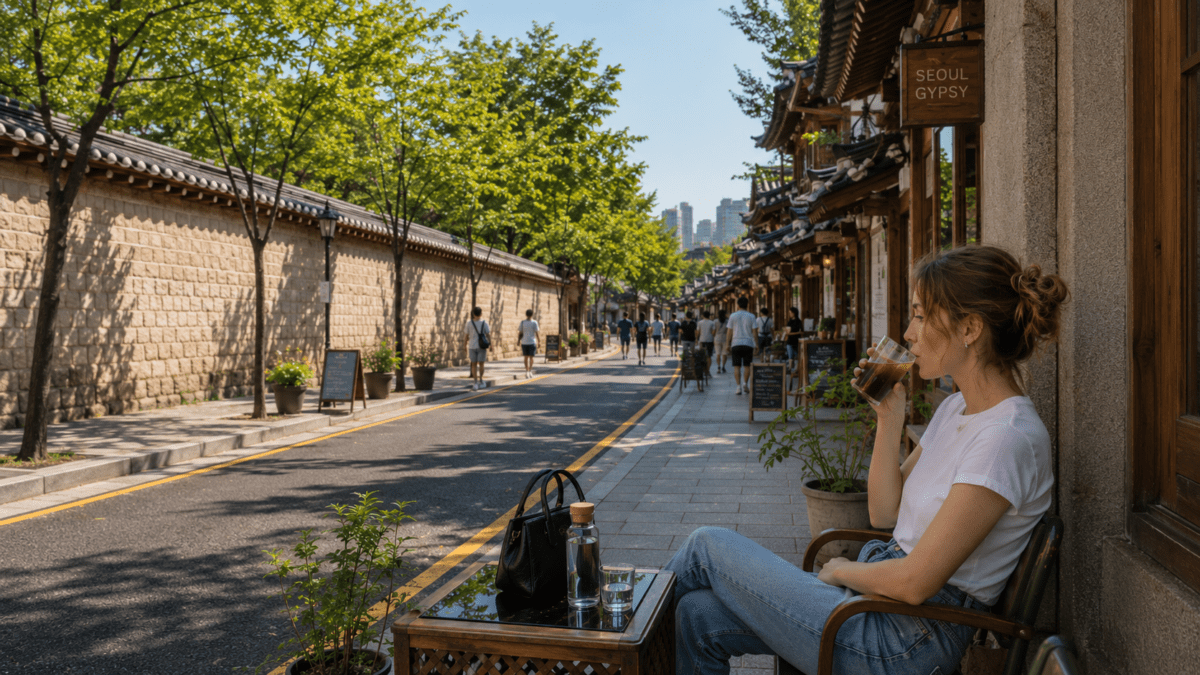
The daytime Ikseon-dong is navigable. You can walk its alleys without stopping to let someone pass. The hanok cafes have seats available. A few tourists move through with cameras, photographing the rooflines. The pace is the pace of a neighborhood that hasn’t started yet.
Seosunra-gil at noon is quieter still. The stone wall catches morning light from the east and holds it without doing anything dramatic with it. A delivery driver parks at the corner and carries boxes into Seoul Gypsy through the back. The outdoor tables are empty and slightly damp from the night before.
The businesses here don’t open early because their customers don’t arrive early. That’s not a complaint — it’s a structural fact. Noon on Seosunra-gil has an unusual quality: it feels like a place resting between uses rather than a place that hasn’t started.
The elderly men in Tapgol Park will be gone by 4 PM. The street will not notice their departure. Someone else is already on the way.
Four O’Clock — The Setup
The pojangmacha on Ikseon-dong’s main approach don’t appear all at once. One tarp goes up. Then a folding table. Then a gas burner on a cart, the kind with the heavy cylinder that takes two hands to carry. By 4:30, what was a walkable lane at noon is beginning to narrow.
The sellers don’t rush. They’ve done this enough times that the setup has its own rhythm — tarp, table, cooler, burner, menu board propped against the cooler because there isn’t anywhere else to put it. The menus are laminated. The prices are written in marker on the laminate because the prices change.
By 5 PM, the smell is already moving: pork belly hitting a hot surface with residual fat, the particular smoke from galmaegissal that reaches the end of the alley before the food does. Someone at the first table of the evening is already ordering.
Ikseondong starts its second version here — not at sundown, not at a particular hour on a clock, but at the moment the first pojangmacha is functional and the first order goes in. Everything after that is accumulation.
The hanok cafes that were half-empty at 2 PM now have people waiting outside. The alleys are narrowing in real time as tables extend into them. The tourists with cameras are still there but now competing for space with people who came specifically to eat.
After Dark — Two Streets, One Circuit
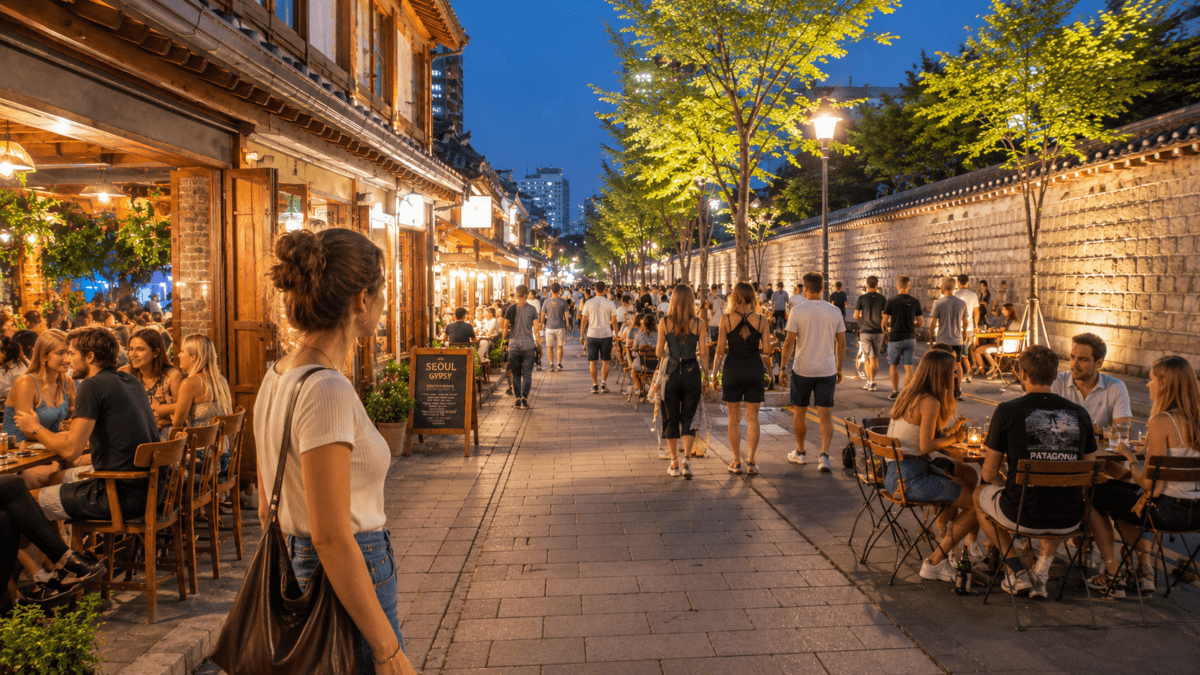
The divergence happens around 8 PM.
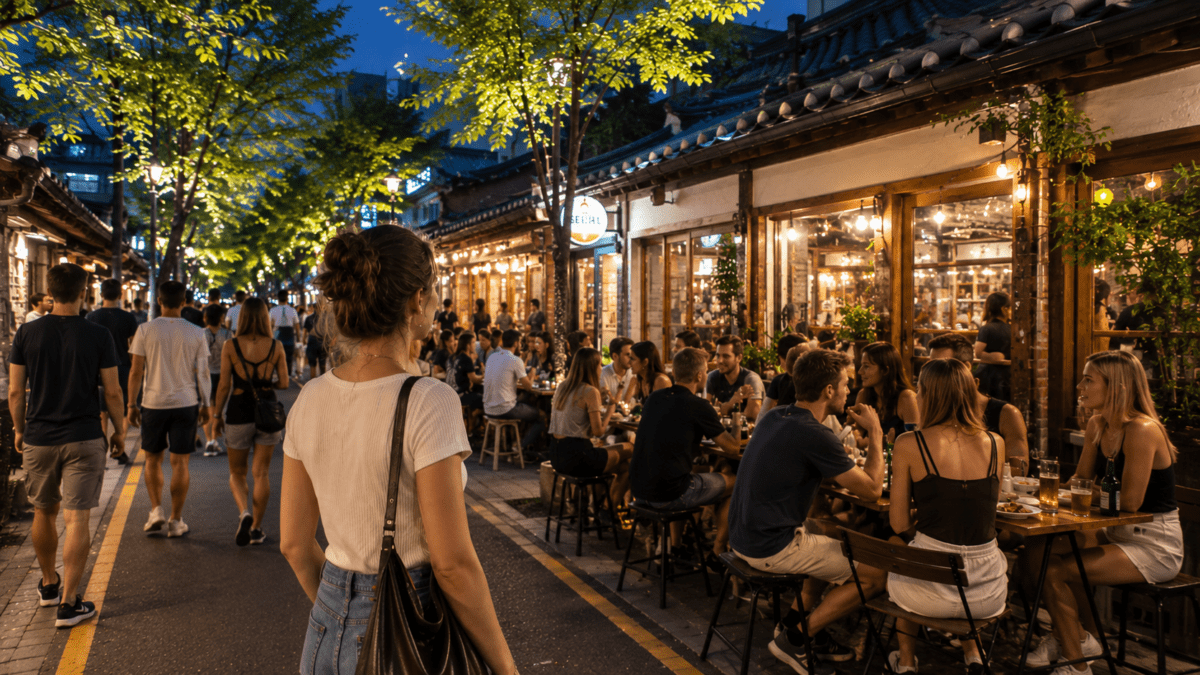
Ikseon-dong hits a noise ceiling. The outdoor tables are full, the indoor tables are full, the queue outside the more popular spots has settled into the resigned patience of people who have already checked that the wait is worth it. Music from two different establishments bleeds into the alley and resolves into something neither intended.
Two minutes on foot, Seosunra-gil is operating at a different frequency.
The stone wall at night is lit from below, indirectly — the kind of lighting that doesn’t call attention to itself but makes the gray stone warmer than it has any right to be at 9 PM. The buildings are low enough that the sky is still present overhead. People walk here rather than standing. It’s a moving street in the evening, not a destination street, which changes the pace of everything on it.
Two people stop at the midpoint of the wall. One of them raises a phone. The other adjusts position slightly, then holds still. The shot they’re after is the wall at this specific angle — the light catching the texture of the stone, the low roofline of the building opposite, enough sky above to keep it from feeling enclosed. They take three, check, take two more. Then they keep walking. Nobody directed them to that spot. The wall just makes the same offer to everyone who passes.
At night, Seosunra-gil is where you go when Ikseon-dong gets loud but you’re not done for the evening. A glass of something at Seoul Gypsy, the window seat close enough to the street that the wall is part of the view. A table at Sunragil Bibi where the room fills without tipping into noise, and the conversation carries without competing with anything. The stone wall visible through every window on this side of the street, doing nothing, being exactly what it is.
A neighborhood shouldn’t be able to hold both of these simultaneously — the concentrated heat of pojangmacha and the specific quiet of a stone wall walk — within ten minutes of each other. The circuit that runs through Ikseondong is what happens when a city accidentally builds room for both.
3 AM — and the Reset
The subway stops running around midnight.
Ikseon-dong Seoul doesn’t care. The pojangmacha that started at 4 PM are still operational at 1 AM, and at 2 AM, and past 3 AM. The burner is still lit. The gas burner is still lit. Someone is still ordering.
Seosunra-gil goes dark earlier — most of its businesses close by midnight or just after. The stone wall at 1 AM is quiet in the way of something that has been there for centuries and will still be there at 8 AM. Which it will.
At some point between 3 and 4 AM, the pojangmacha begin to disassemble in the same order they went up: menu board, cooler, burner, table, tarp. The lane that had narrowed to single-file passage by 6 PM gradually reopens. This is what a directional shift looks like when the structure is right — not dramatic, not announced, just the next phase starting. The pavement emerges. The wall, which had disappeared behind the press of bodies, becomes visible again. The street remembers what it looked like before the evening arrived.
By 8 AM, the street is clean. Not cleaned — clean, as if the previous twelve hours negotiated a truce with the next twelve and agreed to leave no evidence. The delivery driver is back at Seoul Gypsy. The bench in Tapgol Park is occupied again. The man with the thermos may or may not be the same one from yesterday.
The cycle doesn’t announce its reset. It just runs.
This post was planned and edited by a human, with AI assistance.