

The receipt says 6,500 won.
That’s what she paid. An Americano, medium size, no modifications. At current exchange rates, roughly five dollars. In most cities, that buys you a drink and a seat for as long as it takes to finish the drink — thirty minutes, maybe forty-five if the place isn’t busy. Under cafe culture in Korea, it buys something else entirely.
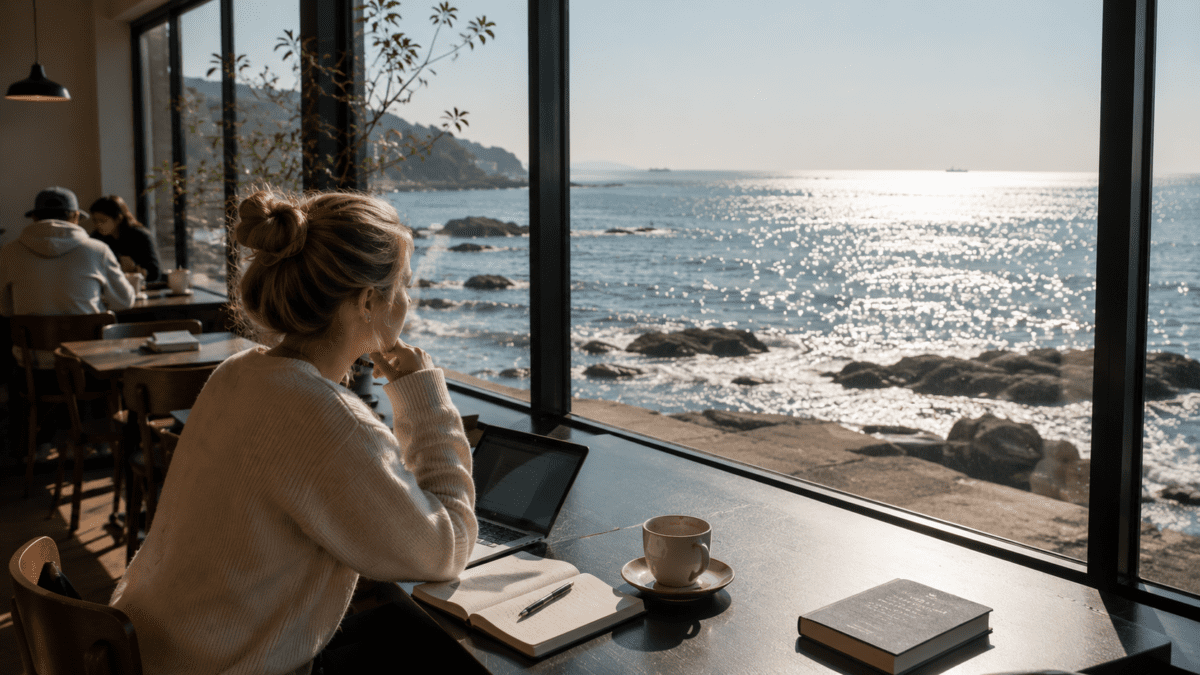
Three hours later, the cup is empty and the seat is still hers. Nobody has come to the table. No second menu has appeared. No staff member has found a reason to hover nearby. The transaction closed the moment the drink was delivered, and everything that followed came with the original purchase without anyone ever having to say so.
This is Korean café time culture reduced to its most basic arithmetic: one purchase, indefinite occupation, zero social cost. The economics are unusual. The logic, once you understand it, is not.
Why No One Asks You to Leave

The absence of the check-in is not an oversight.
In cafés built around table turnover — the model that dominates most Western commercial café culture — the staff check-in serves a dual purpose. It performs hospitality while simultaneously measuring how close you are to finishing. A refill offer is also a progress report. Are you still here? Are you almost done? The friendliness is real, but so is the function underneath it.
Cafe culture in Korea runs on a different model. The assumption built into the design is that you will stay. The question is not whether you’ll leave soon — it’s whether the environment will hold your attention long enough to justify the space you’re occupying. That’s the operator’s problem to solve, not the customer’s obligation to manage.
This means the staff interaction ends earlier and more completely. The drink arrives. Any immediate issues are addressed. And then the staff retreats — not out of indifference, but out of a tacit agreement that the customer has paid for the space and what happens in it is now their business. Checking in would be a violation of that agreement, not a service.
From a table-turnover perspective, this looks like lost revenue. From a Korean café time culture perspective, it looks like the model. The customer who stays three hours and orders once is not a problem to be managed. They are the target demographic — someone who values the space enough to occupy it fully, and whose sustained presence contributes to the atmosphere that makes the next customer want to come in.
Time Sold as a Product
Most cafés sell drinks. Some sell food. Korean cafés sell time.
Not explicitly — there is no hourly rate posted on the wall, no timer that starts when you sit down. But the pricing structure reflects it. A drink at a Korean café costs more than the same drink from a convenience store two doors down. The markup is not for the coffee. The convenience store coffee is often quite good. The markup is for the chair, the table, the outlet, the wifi, the playlist, the lighting calibrated for screens, and the implicit license to occupy all of it for as long as you need.
Korean café time culture has priced the experience rather than the product. The Americano is the entry mechanism — the transaction that unlocks the space. What you do in the space, and how long you stay, is your own arrangement.
This model requires a specific kind of trust. The operator trusts that customers will not abuse the arrangement — that someone who sits for four hours on one drink is contributing to the room in a way that justifies the space they’re taking up. The customer trusts that the operator will maintain the conditions that make four hours sustainable — the wifi will stay reliable, the music won’t get too loud, the temperature will stay reasonable.
Both sides keep their end without a contract, without discussion, without ever naming the arrangement out loud. It runs on shared understanding, reinforced by repetition. You learned it by watching what other people did. They learned it the same way.
The Business That Runs on Atmosphere
A café full of people who are staying is a different commercial object from a café full of people who are leaving.
The density that visitors notice when they walk past Korean cafés — every seat occupied, heads down, nobody in a hurry — is not incidental to the business model. It is the product. An empty café in Korea is a problem. A full one, even if every customer has been there for two hours on a single drink, is functioning correctly.
This works because Cafe culture in Korea has developed around atmosphere as a durable asset. A room full of people working and reading and having quiet conversations produces a specific quality — something between productivity and permission, between public and private. That quality is what draws the next customer in off the street. Not the coffee, not the menu, not the promotional offer. The room itself, as it looks from the outside.
Operators understand this. The investment in design — the raw concrete walls, the pendant lighting, the carefully considered furniture — is an investment in the atmosphere that makes the model sustainable. A beautiful room full of people staying produces more foot traffic than an efficient room that turns tables quickly. The customer who occupies a seat for three hours is not a liability. They are part of what makes the room worth entering.
This is why the music is calibrated rather than random — research confirms that softer music encourages customers to stay longer, slowing movement and creating comfort for reading and working. The lighting is warm rather than bright, the tables spaced for privacy rather than packed for capacity. Every design decision supports the atmosphere that supports the model. Korean café time culture, at the commercial level, is a bet that people will pay a premium to be in a well-designed room where nobody is going to rush them. There’s something in that logic that runs deeper than business — the weight that doesn’t shift is what makes a room worth returning to.
So far, the bet has paid off. Walk into any well-designed café in Yeonnam-dong or Seongsu on a Saturday afternoon and the evidence is visible in real time — every seat taken, nobody leaving, the room doing exactly what it was designed to do. The atmosphere is the product. The coffee is just the reason the door opened.
What Not Being Rushed Is Worth
There is a specific kind of value that doesn’t appear on any balance sheet.
It’s the value of two hours that belonged entirely to you. No agenda, no performance, no social obligation that required anything beyond ordering something at the counter. Time that didn’t feel like it was being monitored or measured or quietly pressured toward an end. Time that was just — yours.
Korean café time culture has made this available at the cost of a single drink, and the demand for it shows no sign of softening. In a city that runs on visibility and output and the constant low-grade pressure of being seen to be productive, the café is the place where the pressure goes when it needs somewhere to go.
What not being rushed is worth is different for everyone. For the freelancer between projects, it’s the three hours that don’t have to be explained to anyone. For the student who needs to read forty pages before tomorrow, it’s the uninterrupted stretch that a small apartment can’t provide. For the woman who always takes the same seat at the second table from the window, it’s something harder to name — a reliable coordinate in a week that doesn’t always hold its shape.
The drink costs 6,500 won. What it purchases is not coffee.
It purchases the right to be somewhere without being watched, to stay without being asked to leave, to let an afternoon pass at whatever pace the afternoon requires. In most cities, that’s not for sale. In Korea, it comes with the Americano.
Content in this post was created with AI assistance