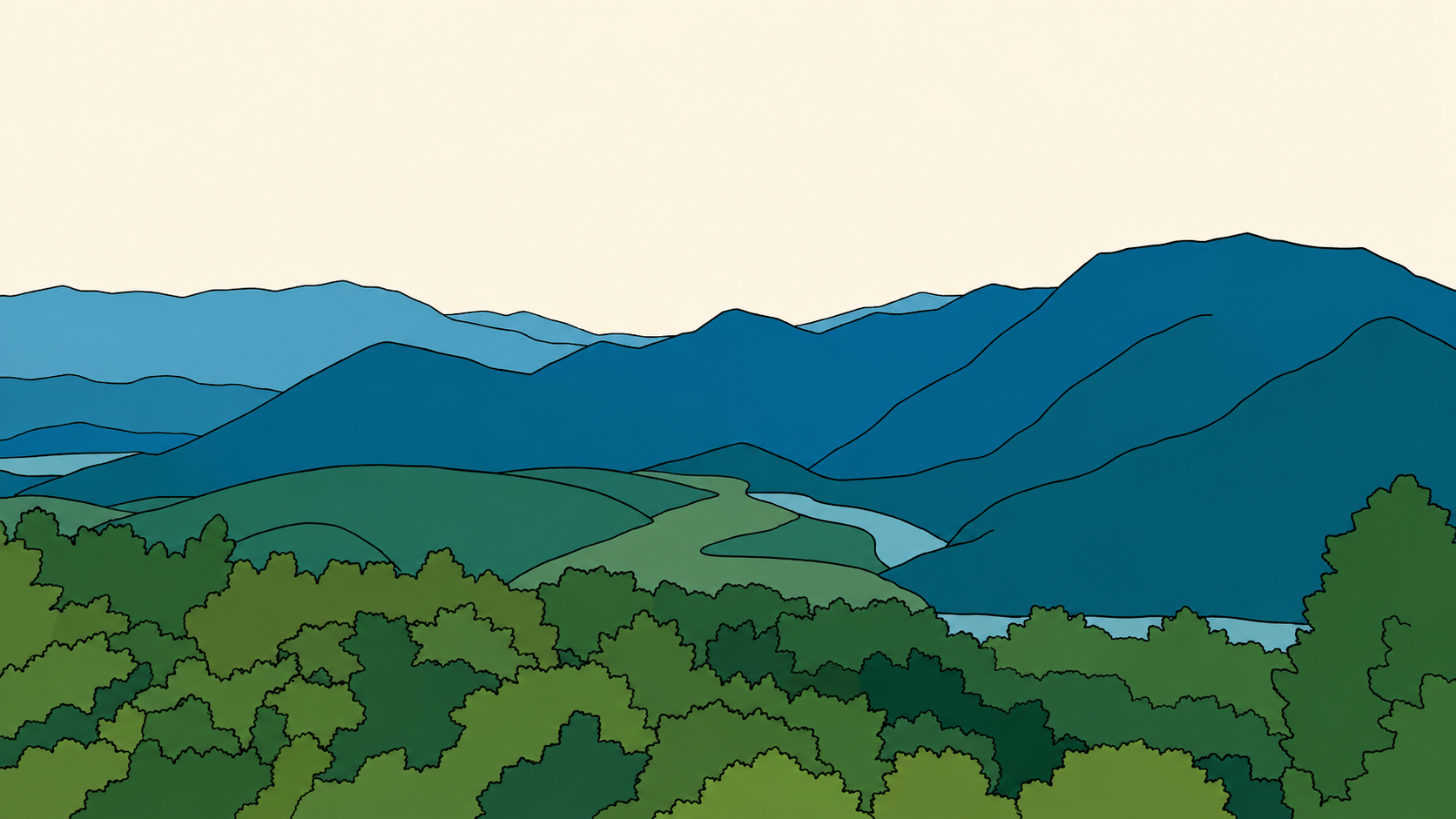

The mountain doesn’t move toward the storm. The storm moves through the mountain.
Mu (무: mu, yang earth) is not a force that initiates, navigates, or outputs. It receives. Everything directed at it — pressure, energy, conflict, demand — lands on Mu (the mountain) and is absorbed without the surface shifting. This is not passivity. A mountain doesn’t yield because it can’t fight back. It holds because holding is what it is built to do.
The yang earth stem in K-Saju is the fifth Heavenly Stem and the yang expression of Earth (토: to). In K-Saju, Earth governs stability, containment, and the capacity to receive and transform what other elements produce. In its yang form, that capacity is total and unconditional. Mu (the mountain) doesn’t select what it absorbs. It doesn’t modulate its response based on what’s coming in. It receives everything, holds everything, and remains what it was before the storm arrived.
The Weight That Doesn’t Shift

Mu (yang earth, the mountain) operates on a principle that no other stem in the ten characters shares: stability as the primary output. Every other stem produces something that moves — Gap (갑: gap, yang wood, the sprout) drives forward, Eul (을: eul, yin wood, the vine) navigates, Byeong (병: byeong, yang fire, the sun) radiates, Jeong (정: jeong, yin fire, the candle) concentrates. Mu (the mountain) produces none of these. What Mu produces is the condition under which all of them can operate. It is the ground.
In K-Saju, Mu (the mountain) is the yang expression of Earth (토: to). Earth as an element governs stability, containment, and the capacity to receive what other elements produce and hold it without loss. In its yang form, that capacity is structural and total. Mu doesn’t receive selectively. It doesn’t modulate its response based on what’s arriving. The mountain receives rain and sun and wind and snow with the same surface. What changes is the weather. What doesn’t change is the mountain.
This is the mechanism that makes Mu the most consistently underestimated stem in the chart. The stems that initiate, radiate, and navigate are visible in their output. Mu’s output is the absence of collapse. When a chart is running through conditions that would destabilize any other configuration — heavy controlling pressure, Daewoon (대운: dae-woon, ten-year cycle) conflict, elemental imbalance — a Mu Day Stem (일간: il-gan, primary stem) holds the structure. Not because it resolves the pressure. Because it absorbs it without the center giving way.
The contrast with Gi (기: gi, yin earth, the field) clarifies what makes Mu’s mechanism specific. Both are Earth stems. Both govern stability and containment. But where Mu holds unconditionally — receiving everything without selection — Gi (yin earth, the field) processes. Gi takes what arrives, transforms it, and produces something usable from the input. Mu doesn’t transform. It holds. The field processes what falls on it into crops. The mountain holds what lands on it and remains a mountain. Two expressions of the same element, two fundamentally different functions.
In the chart, a Mu Day Stem identifies a person whose primary operating mode is structural stability under load. They are not the person who initiates the project, navigates the obstacle, or fills the room with energy. They are the person who is still there when the project has collapsed twice and the team has fractured and the deadline has moved again. Their presence doesn’t solve the problem. It prevents the problem from becoming a dissolution. The chart holds because Mu holds.
What this means for the reading is significant. Mu charts are chronically misread as passive or underpowered because the output is not directional. Nothing is being driven, navigated, or radiated. But the structure is standing. In environments that require sustained stability under sustained pressure — and most environments eventually do — a Mu Day Stem running in favorable conditions is the variable that makes everything else possible.
Mu doesn’t move. It makes it possible for everything else to.
Four Ways the Mountain’s Holding Becomes a Liability

Mu (yang earth, the mountain)’s failure is not collapse — it is the weight accumulating past what the surface can distribute.
The pattern looks like this: Mu has been absorbing. The pressure has been consistent — elemental conflict in the chart, a Daewoon (ten-year cycle) running against the structure, demands from every direction landing on the same surface. Mu has held. That is what it does. But holding without release is not the same as holding without cost. The mountain doesn’t crack. The soil beneath it compresses. The weight accumulates in ways that don’t show on the surface until the surface can no longer distribute it.
This is Mu’s primary failure pattern: absorption without release until the load exceeds the structural capacity.
The second pattern is isolation. Mu (yang earth) holds the center. For that center to be useful, other elements need to be moving around it — Wood growing out of it, Fire warming it, Metal refining what it contains, Water softening its edges. When the chart strips away those surrounding elements — when the Daewoon (ten-year cycle) removes the dynamic forces that give Mu’s stability a purpose — the mountain is still there. But there is nothing moving through it, nothing growing on it, nothing being refined within it. The stability becomes stagnation. Mu is holding everything in place, but the place is empty.
The third pattern is elemental. Wood breaks Earth in the controlling cycle (상극: sang-geuk, mutual constraint) — Gap (yang wood) or Eul (yin wood) in a dominant position exerts direct controlling pressure on Mu. For a yang stem of Mu’s structural density, this constraint doesn’t feel like being cut — it feels like being broken apart from below. The roots go deeper than the surface. The pressure is slow, persistent, and structural.
A single Wood stem in a compatible position gives Mu’s stability definition — something to hold against, which gives the holding purpose. Multiple Wood stems in dominant positions is a different reading. The chart is working to fracture the foundation rather than build on it.
The fourth pattern is excess Earth. A chart with multiple Earth stems alongside Mu — particularly Gi (yin earth) in adjacent positions — produces a different problem. Too much Earth in the same chart doesn’t double the stability. It produces a density that nothing can move through. Wood can’t grow. Water can’t flow. Fire produces heat that has nowhere to convert. The very element that makes Mu’s stability useful becomes the condition that makes everything else impossible. The mountain is so large it has become the terrain itself. Nothing can get around it.
All four patterns converge on the same structural fact: Mu is still holding. What varies is whether the holding has a purpose, a cost, or a limit. Mu is still absorbing, still holding, still maintaining the center. The problem is not the stability. The problem is the absence of release, the isolation of the center from dynamic forces, the structural pressure from below, or the excess that turns containment into blockage.
Mu doesn’t fail by moving. It fails by holding everything so completely that nothing else can.
What Has to Be Moving Around Mu for the Stability to Matter

Timing for the yang earth stem in K-Saju is not motivational. It is structural. Mu (yang earth, the mountain) doesn’t perform better when the person tries harder to be stable or commits more consciously to holding the center. It performs better when the chart’s relational conditions create dynamic forces moving around the stability — elements that need the ground, use the ground, and give the ground a purpose.
Three structural conditions make Mu’s unconditional stability useful rather than simply present.
The first is Fire generating Earth. In the generative cycle (상생: sang-saeng, mutual nourishment), Fire produces Earth. When the chart carries strong Fire stems or branches — Byeong (yang fire, the sun) or Jeong (yin fire, the candle) — the Earth element is being supplied from above. For Mu (yang earth, the mountain), this supply does something specific: it warms the surface. Cold earth holds. Warm earth receives and transforms. A Mu chart with Fire support doesn’t just absorb pressure — it converts what it absorbs into something the surrounding elements can use. The mountain becomes fertile ground rather than bare rock.
The second is the dynamic surrounding. Mu’s stability is most useful when other elements are actively moving around it. Wood growing through it gives the stability definition — something is using the ground, which means the ground is doing its work. Metal refining within it gives the containment precision — something is being shaped by what Mu holds. Water flowing across it gives the surface purpose — the mountain channels what moves through it rather than simply blocking it.
A Mu chart running through a Daewoon (ten-year cycle) that activates Wood, Metal, or Water elements is a chart where Mu’s unconditional stability becomes the condition that makes those elements more effective than they would be without a ground to operate from.
The third is the Daewoon (ten-year cycle) alignment. A Mu (yang earth, the mountain) Day Stem (일간: il-gan, primary stem) running through a Fire-dominant Daewoon (ten-year cycle) is in its structural window. The ten-year cycle is warming the surface and supplying the Earth element from above. This is when Mu’s capacity to receive and hold runs at its designed function — not just absorbing but converting, not just holding but providing the condition under which dynamic forces can do what they are built to do. A Daewoon (ten-year cycle) that also activates compatible Metal elements gives Mu’s containment both warmth and precision simultaneously.
The inverse configurations are equally readable. A Mu (yang earth, the mountain) Day Stem running through a Wood-dominant Daewoon (ten-year cycle) is under direct structural pressure — the roots are going deeper, the fracture pressure is building from below. The center is still holding. The cost of holding is rising.
A Water-dominant Daewoon (ten-year cycle) produces a different problem: Earth absorbs Water in the controlling cycle (상극: sang-geuk, mutual constraint), which means Mu is consuming its own structural integrity to contain the Water element. The mountain is holding the flood. How long it can hold depends on how much Water the cycle is sending.
The question that matters most for a Mu chart: not whether the stability is present — it always is — but whether the current Daewoon (ten-year cycle) is surrounding that stability with dynamic forces that give it purpose, or isolating it in conditions where holding becomes the only thing happening.
Mu performs at peak when the ground is warm, the dynamic forces are moving, and the cycle is giving the stability something worth holding for.
Fire, Dynamic Forces, and the Reading the Surrounding Elements Make
Mu (yang earth, the mountain) requires dynamic forces around it to give the stability something to hold for. The stability is real and it is structural, but it requires dynamic forces moving around it to be useful rather than simply present. What surrounds Mu in the chart determines whether that unconditional holding becomes the ground that makes everything else possible, or a density that nothing can move through.
The most important relationship is between Mu and Fire. Byeong (yang fire, the sun) or Jeong (yin fire, the candle) generating Mu from above is not just a supply line — it is the difference between a mountain that is bare rock and a mountain that is fertile ground. Without Fire, Mu’s absorption is cold and structural — it holds, but it doesn’t convert. With Fire, the surface warms.
The absorbed energy doesn’t just sit in the structure — it becomes something the surrounding elements can use. A Mu chart with strong Fire support running through a favorable Daewoon (ten-year cycle) is a chart where the stability is active rather than inert. The mountain is doing something with what it holds.
The relationship with Wood is the most critical constraint. Gap (yang wood, the sprout) or Eul (yin wood, the vine) in dominant positions exerts controlling pressure on Mu — Wood breaks Earth in the controlling cycle (상극: sang-geuk, mutual constraint). The reading question is not whether Wood is present — some Wood in the chart gives Mu’s stability definition and purpose. The question is the degree. A single strong Wood stem gives the mountain something to hold against. Multiple dominant Wood stems are fracturing the foundation from below. The same element in different proportions produces fundamentally different chart readings.
Metal in the chart is what gives Mu’s containment precision. Gyeong (경: gyeong, yang metal, the blade) or Sin (신: sin, yin metal, the gem) within Mu’s structural field refines what Mu holds. Earth generates Metal in the generative cycle — Mu is the source material from which Metal emerges. When Metal is present in compatible positions, Mu’s unconditional holding becomes selective precision: the mountain is not just absorbing everything, it is producing something exact from what it contains.
A Mu chart with strong Metal in favorable positions tends to produce people whose stability is not just structural but surgical — they hold the center and cut what doesn’t belong, without the center shifting.
Water in the chart requires careful reading. Earth absorbs Water in the controlling cycle — Mu controls Im (임: im, yang water, the river) and Gye (계: gye, yin water, the dew). This sounds like strength. In practice, it creates a specific liability: a Mu chart that is absorbing heavy Water is consuming structural integrity to contain the flow. The mountain holds the flood, but holding a flood is not the same as being a mountain.
The capacity is being redirected from stability into containment of an active force. When the Daewoon (ten-year cycle) sends heavy Water into a Mu chart, the reading needs to assess whether the chart has sufficient Fire to warm the surface and sufficient Metal to give the absorption precision — or whether Mu is simply holding everything it can until it can’t.
The strategic read for a Mu chart starts with the surrounding dynamic. What is moving around the mountain? Fire warming it, Wood growing through it, Metal refining within it, Water flowing across it — each produces a different reading of the same stable center. Mu without dynamic forces around it is a mountain in an empty landscape. The stability is real. There is nothing it is stable for.
The stability in a Mu chart is structural — it does not disappear under pressure. What the reading examines is whether anything is moving across it that makes the holding necessary. It reads whether the conditions around the yang earth stem in K-Saju are set up to let that ground become fertile rather than just solid.
Mu doesn’t need to move. It needs something worth holding.
A team has been in crisis for six months. The project has collapsed twice. Three people have left. The deadlines keep moving. The person running the center of it hasn’t left. Hasn’t shifted. Hasn’t announced that they’re still there — they’re just still there.
No one in the room can name exactly what they’re holding. They just know that when that person is present, the structure doesn’t dissolve.
That is the chart reading. Not what Mu produces. What Mu makes possible.
Content in this post was created with AI assistance.