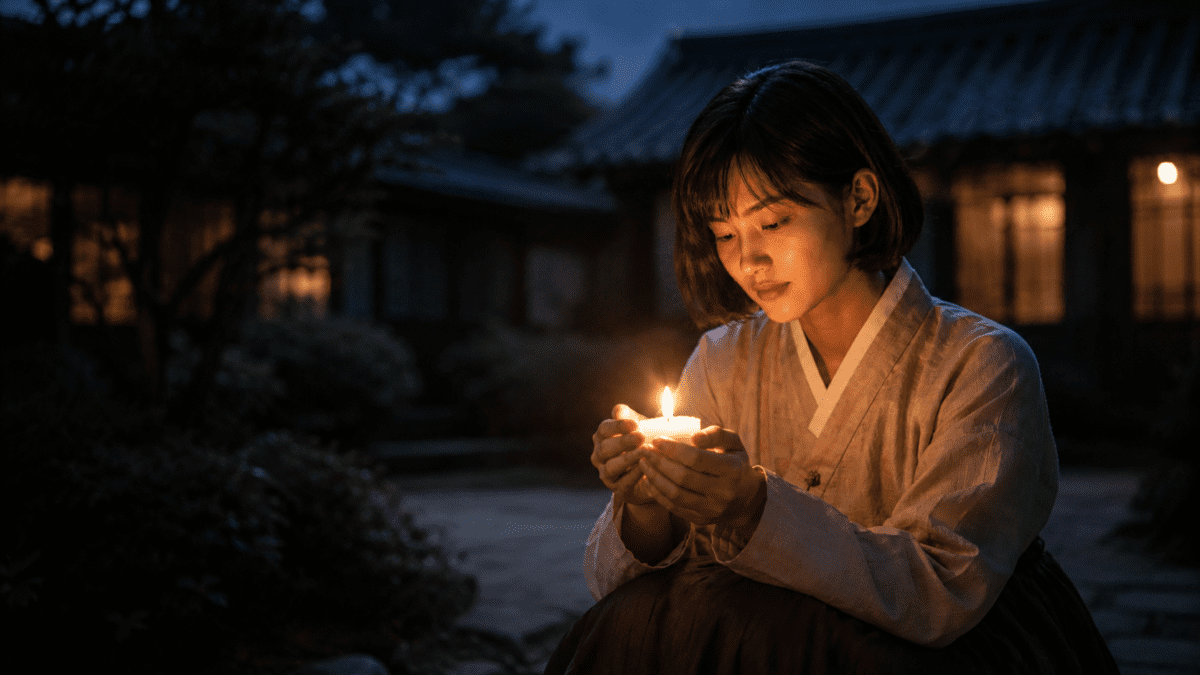
The candle stays lit through the open window. The wind comes in, moves around the room, leaves. The flame bends. It doesn’t go out.
Jeong (정: jeong, yin fire, the candle) is not the sun. It doesn’t fill the space or raise the temperature of every surface in range. It holds one point of heat, sustained and precise, in a structure small enough to protect it. Where Byeong (병: byeong, yang fire, the sun) outputs in all directions at full intensity, Jeong concentrates. The output is smaller. The duration is not.
The yin fire stem in K-Saju is the fourth Heavenly Stem and the yin expression of Fire (화: hwa). In K-Saju, Fire governs visibility, expression, and the conversion of energy into heat and light. In its yin form, that conversion is selective and contained. Jeong doesn’t output everything it has. It outputs what the structure can sustain — and it keeps outputting, at that level, for as long as the structure holds.
The Contained Flame
Jeong (yin fire) operates on a principle that distinguishes it from every other Fire stem and from most yang stems: output within structure. The mechanism doesn’t radiate — it concentrates. Where Byeong (yang fire) fills whatever space it enters, Jeong selects a point and holds it. The heat is real and it is sustained, but it is directed. A candle doesn’t warm a room. It warms the space directly in front of it, at close range, with precision that a sun cannot achieve.
In K-Saju, Jeong is the yin expression of Fire (화: hwa). Yin and yang within the same element are not opposites — they are the same energy expressed through different mechanisms. Byeong and Jeong both govern visibility, expression, and conversion. But where Byeong’s conversion is total and ambient, Jeong’s is selective and contained. Byeong (yang fire) outputs everything at maximum rate. Jeong outputs what the structure allows, at a rate the structure can sustain, for as long as the fuel and the container hold.
The structure is the key variable. Jeong requires something to burn within — a container that defines the space of the flame, protects it from dispersion, and gives the output somewhere specific to go. Without that structure, Jeong’s heat dissipates. Not because the output stops, but because there is nothing to direct it. A candle in open air on a windy night doesn’t go out immediately. It burns lower. It flickers. The heat is still there. It just isn’t landing anywhere.
The contrast with Byeong (yang fire) clarifies what makes Jeong’s mechanism specific. Both stems produce heat and light. Both are visible. But Byeong’s visibility is ambient — everyone in range notices the temperature change. Jeong’s visibility is directed — the person directly in front of the flame sees it clearly. The person across the room may not notice it at all. This is not a weakness in the design. It is the design. A surgical lamp and a floodlight are both light. They are not interchangeable.
In the chart, a Jeong Day Stem (일간: il-gan, primary stem) identifies a person whose primary operating mode is sustained, directed output within a defined structure. They don’t broadcast — they illuminate the specific thing they are pointed at. They don’t activate rooms — they change the person or project directly in front of them. The influence is deep rather than wide. The relationship that receives Jeong’s full attention is transformed in ways that Byeong’s ambient radiation cannot produce— because the heat is concentrated rather than distributed.
What this means for the chart reading is significant. Jeong charts are chronically underread because the output is not ambient. The room doesn’t feel different when a Jeong Day Stem enters. The person across the table does. The reading needs to locate what Jeong is pointed at — what structure it is burning within — and assess whether that structure is the right one for the conditions the chart is running in.
Jeong doesn’t fill the room. It changes what it’s directly pointed at.
Four Ways the Concentrated Flame Fails Its Container
Jeong (yin fire)’s failure is not dimming — it is the flame continuing to burn inside a structure that has stopped serving the output.
The pattern looks like this: Jeong has identified a structure — a relationship, a project, a role — and directed its full, concentrated heat toward it. The structure worked. The heat landed. Something was transformed. Then the conditions around the structure changed. The project ended. The relationship shifted. The role no longer required what Jeong was producing. The structure is no longer the right container. Jeong doesn’t read this as a signal to redirect. It continues burning within the same structure, at the same intensity, toward something that is no longer receiving the heat the way it once did.
This is Jeong’s primary failure pattern: sustained output into a structure that no longer holds what it receives.
The second pattern is structural isolation. Jeong (yin fire) requires a container to function at its designed capacity. When the chart or the current Daewoon (대운: dae-woon, ten-year cycle) removes or destabilizes the structures that Jeong burns within — when the relationships dissolve, the projects end, the roles disappear — Jeong’s output has nowhere to go. The flame is still burning. The container is gone. The heat disperses rather than concentrates. From outside, this looks like a loss of energy or motivation. The mechanism is intact. The problem is structural absence, not internal depletion.
The third pattern is elemental. Water controls Fire in the controlling cycle (상극: sang-geuk, mutual constraint) — Im (임: im, yang water, the river) or Gye (계: gye, yin water, the dew) in a dominant position dampens the output. For Byeong (yang fire), Water constraint is felt as a dampening of ambient radiation — the room gets cooler, but the sun is still there. For Jeong (yin fire), Water constraint is felt differently: the flame goes lower. The structure is still present. The heat is still directed. But the intensity drops to the point where the output is no longer sufficient to transform what it’s pointed at. The candle is burning. The wax is melting. The light isn’t reaching.
The fourth pattern is the absence of Wood. Wood generates Fire in the generative cycle (상생: sang-saeng, mutual nourishment) — Gap (갑: gap, yang wood, the sprout) or Eul (을: eul, yin wood, the vine) supplying the fuel from below. Without Wood support, Jeong burns through whatever stored energy the chart carries. Unlike Byeong (yang fire), whose depletion is gradual and visible as a drop in ambient temperature, Jeong’s depletion is localized. The person isn’t less warm in general. They are less able to sustain the specific point of heat that the structure requires. The flame gets smaller. The precision doesn’t change. The range does.
All four patterns point to the same underlying condition: the flame is burning. What varies is whether the container, the supply, or the control is the source of the problem. Jeong is still burning, still directed, still concentrated. The problem is not the fire. The problem is either the wrong structure, the absent structure, the controlled output, or the depleted fuel. Each produces a different reading.
Jeong doesn’t fail by going out. It fails by continuing to burn inside a structure that can no longer hold what it’s producing.
The Container, the Fuel, and When Jeong Transforms Rather Than Just Burns

Timing for the yin fire stem in K-Saju is not motivational. It is structural. Jeong (yin fire) doesn’t perform better when the person focuses harder or commits more deeply to what they’re doing. It performs better when the chart’s relational conditions provide the right container and the right fuel supply — a structure worth burning within, and the resources to sustain the burn.
Three structural conditions allow Jeong’s concentrated heat to reach the threshold that produces lasting transformation.
The first is Wood generating Fire. In the generative cycle (상생: sang-saeng, mutual nourishment), Wood feeds Fire. When the chart carries strong Wood stems or branches — Gap (yang wood) or Eul (yin wood) — the Fire element has a sustained supply line. For Byeong (yang fire), this supply fuels ambient radiation. For Jeong (yin fire), it does something more specific: it sustains the intensity of the concentrated flame. Wood support is what separates a Jeong chart that burns steadily within its structure from one that burns lower and lower until the output no longer reaches what it’s pointed at. The flame doesn’t need more space. It needs more fuel to hold the same temperature.
The second is the structure itself. Unlike the other stems, Jeong’s peak performance depends not just on elemental configurations but on the presence of a worthy container. Earth (토: to, integration force) in the chart — Mu (무: mu, yang earth, the mountain) or Gi (기: gi, yin earth, the field) — provides the grounding structure that Jeong’s output can land in and accumulate within. When Earth is present and stable, Jeong’s concentrated heat doesn’t dissipate — it converts into something that holds. The warmth becomes foundation. The illumination becomes clarity that stays. A Jeong chart with strong Earth in favorable positions tends to produce sustained, transformative influence in the specific relationships and projects it directs its output toward — not because the influence is wide, but because it is precise and the container holds it.
The third is the Daewoon (ten-year cycle) alignment. A Jeong (yin fire) Day Stem running through a Wood-dominant Daewoon is in its structural window. The ten-year cycle is supplying the fuel the concentrated flame needs. This is when Jeong’s sustained, directed output runs at full intensity — the same person, the same chart, the same operating mode, but the cycle is replenishing what the structure is consuming. A Daewoon that also activates compatible Earth elements gives Jeong’s output both fuel and container simultaneously. These are the periods when Jeong charts produce their most visible and lasting influence — not in the ambient way that Byeong charts do, but in the specific, deep transformation of whatever the flame is pointed at.
The inverse configurations are equally readable. A Jeong (yin fire) Day Stem running through a Water-dominant Daewoon is under controlling pressure — the cycle is dampening the flame’s intensity below the threshold needed to transform what it’s pointed at. The structure is still present. The output is still directed. The heat isn’t sufficient. A Wood-deficient Daewoon leaves Jeong burning through reserves — the flame holds its direction but loses intensity gradually, in a way the person experiences as the specific relationship or project becoming less responsive rather than as their own energy dropping.
The question that matters most for a Jeong chart: not whether the flame is present — it always is — but whether the current Daewoon is supplying the Wood that sustains the intensity and activating the Earth that holds what the output produces. When both are present, the concentrated influence that seems limited in scope becomes the thing that produces the deepest and most lasting change in whatever it touches.
Jeong performs at peak when the fuel is sustained, the container is stable, and the cycle is amplifying the intensity rather than dampening it.
Structure First, Then Fuel — Reading a Jeong Chart from the Outside In

The concentrated flame is real and it is precise, but it requires two things it cannot generate alone: a structure to burn within and a fuel supply to sustain the intensity. What surrounds Jeong in the chart determines whether the directed heat transforms what it touches or dissipates into the space around an empty container.
The most important relationship is between Jeong and its structure. Unlike other stems whose performance depends primarily on elemental configurations, Jeong’s performance depends first on whether the chart contains stable, worthy structures for the flame to burn within. Earth (토: to) in the chart — Mu (yang earth) or Gi (yin earth) — provides the primary container. Earth receives Fire’s output in the generative cycle and holds it. A Jeong chart with strong Earth in favorable positions is a chart that accumulates the output of its concentrated heat into something lasting. The influence doesn’t reach everyone. What it reaches, it changes permanently.
The absence of Earth produces a different reading. Jeong is still burning. The output is still directed. But without a structural container to receive and hold the heat, the precision dissipates. The flame is pointed at something, but the something doesn’t have the capacity to hold what’s being produced. The misread goes like this: the lack of visible, lasting influence gets interpreted as a weakness in the output. The actual problem is the container — or the absence of one.
The relationship with Wood is what determines whether Jeong can sustain its intensity over time. Gap (yang wood) or Eul (yin wood) in the chart generating Jeong from below is the fuel supply. Without Wood support, Jeong burns through whatever stored energy the chart carries — not in the dramatic, ambient way that a depleted Byeong (yang fire) chart shows, but locally. The flame gets smaller. The precision is still there. The reach is not. A chart with strong Wood support is a Jeong chart that can sustain its directed output for as long as the structure holds. The same chart without Wood is a Jeong chart that is rationing its intensity — directing what it has carefully, because what it has is finite.
The relationship with Water is the most critical constraint. Im (yang water) or Gye (yin water) in a dominant position puts Jeong under direct controlling pressure — Water extinguishes Fire. For Jeong (yin fire), this constraint is felt at the level of intensity rather than direction. The flame is still pointed at the right structure. The heat is still reaching it. But the temperature is insufficient to produce transformation. The candle is burning. The wax around it is cold. The reading needs to assess whether the Water in the chart is present in a moderating amount — which focuses the output — or in a dominating amount — which reduces it below the threshold of usefulness.
Metal in the chart adds a dimension specific to Jeong. Fire melts Metal in the controlling cycle — Jeong controls Gyeong (경: gyeong, yang metal, the blade) and Sin (신: sin, yin metal, the gem). For Jeong (yin fire), this relationship is more nuanced than it is for Byeong (yang fire). Jeong’s concentrated heat doesn’t melt Metal indiscriminately — it applies precisely to whatever Metal element is directly in the flame’s range. A single Metal stem in a compatible position can be refined by Jeong’s heat into something exact. Multiple Metal stems under Jeong’s concentrated control produce a chart that is consuming its structural precision faster than it can be restored.
The strategic read for a Jeong chart starts with the container. Where is the Earth? What is the flame burning within? How long can the Wood sustain it, and what is the Water doing to the intensity? The Metal question comes last: is it being refined by the heat, or consumed by it?
These relationships tell you more about how the chart is actually running than the Jeong stem itself. Jeong is the flame. The chart around it is the lantern. The same flame reads differently depending on the quality of the structure that holds it and the supply of fuel that feeds it.
The flame in a Jeong chart is structural — it does not go out on its own. What the reading examines is the quality of the structure it is burning within. It reads whether the conditions around the yin fire stem in K-Saju are set up to let that flame become heat rather than just light.
Jeong doesn’t need a bigger space. It needs a better lantern.
What the chart can show is where the flame is and what it’s burning within. What it cannot always show is whether the structure Jeong has chosen is the right one — whether the heat is landing in something worth transforming, or in something that has already given back everything it can.
That gap between what the data reads and what only the person inside the chart can know — that is where K-Saju reaches its limit. And where the reading becomes a question rather than an answer.
This post was planned and edited by a human, with AI assistance.