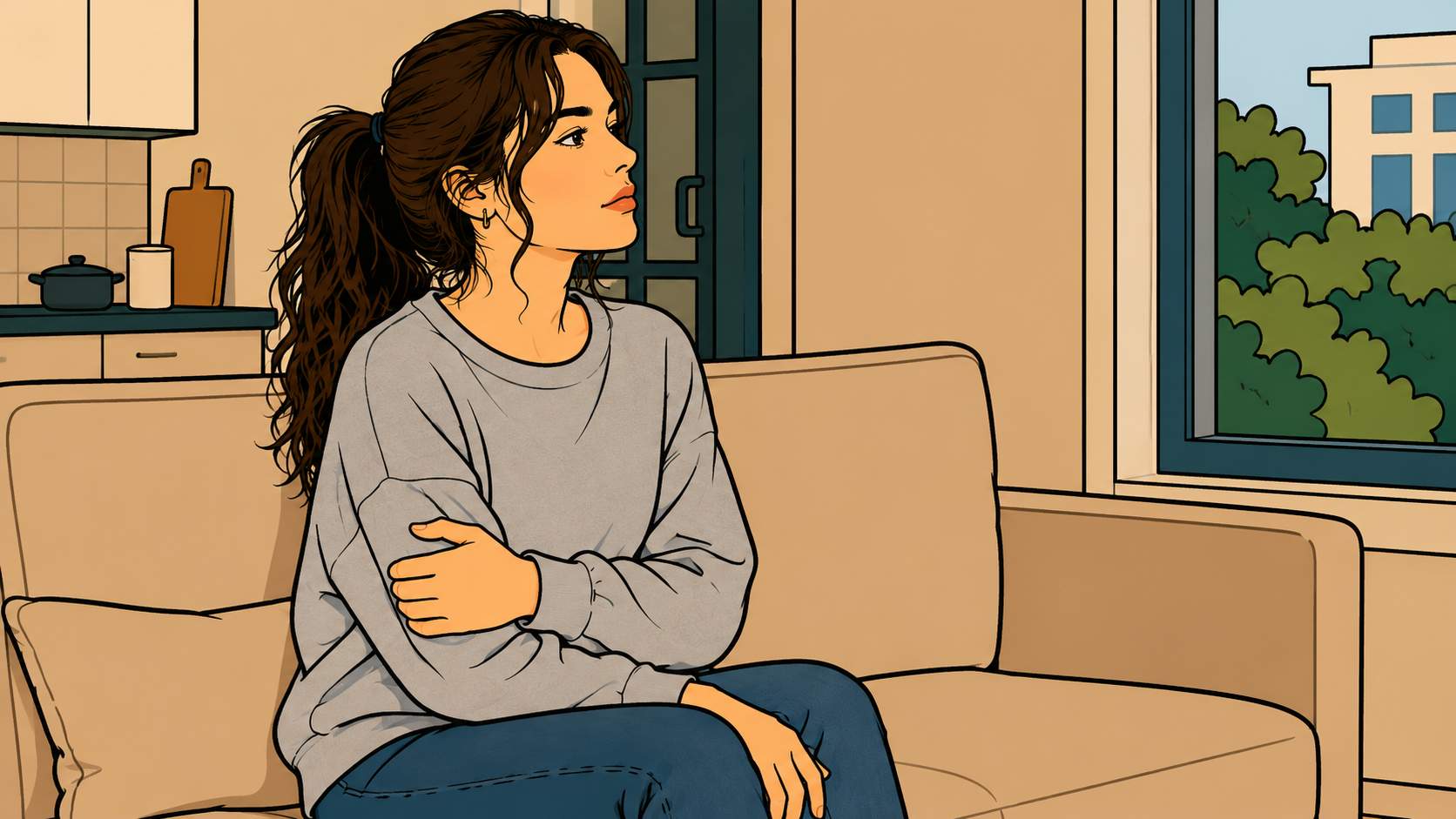

You finally sit down. The list is handled, or handled enough, and there’s a whole evening in front of you with nothing owed. This is the part you were working toward all day. And within about four minutes, feeling guilty for resting goes to work on it.
Not dramatically. Just a low hum that says you should be doing something, even though there’s nothing to do and you already decided that. The rest you earned doesn’t arrive clean; it comes with a supervisor. You shift on the cushion, reach for your phone without deciding to, and the evening you were owed quietly turns into an evening you have to keep justifying.
Somewhere along the way rest stopped being a thing you simply do when you’re tired and became a thing you have to qualify for. That discomfort the moment you stop is the clearest sign of the arrangement — and once you can name it, you start seeing it run under almost every hour you were supposed to be off.
The Rest You Can Only Take After
Notice the word that’s always attached to permission: after.
You can relax after the emails are cleared. After the workout. After the one call you’ve been avoiding. After the counter is wiped and the laundry is at least started. Rest is never the thing you’re doing now; it’s the thing waiting on the far side of a task, and the task is what makes it allowed. Sit down before the after arrives and it doesn’t count — you’re not resting, you’re avoiding, and the difference carries the whole moral weight of the day.
So you keep the couch at arm’s length until you’ve paid the entry fee. You tidy the counter that was fine, answer the message that could wait, top up the list just enough that sitting down feels licensed. And on the days you do pay it, the rest still isn’t quite the reward it was advertised as, because part of you spent the whole climb toward it watching to make sure you’d earned it. You get there tired in a way the rest doesn’t fix, holding a ticket you had to work for, to a show you’re too keyed up to watch.
There’s a quiet cruelty in this that’s easy to miss. Rest is the one thing that isn’t supposed to require anything. It’s meant to be the floor you stand on, not a prize on a shelf you climb toward. The moment it starts asking for a receipt, it stops being rest and becomes another item — the last one, the reward-shaped one, dressed up as a reward but scheduled like a chore, an item all the same.
How Rest Guilt Keeps the “After” Moving
Here’s the trap inside the arrangement: the after is a moving line.
You clear the emails and a new task quietly takes the spot the emails were holding. The condition for resting was never a fixed amount of done; it was a feeling of done, and the feeling recedes exactly as fast as you approach it. There’s always one more thing that would make the rest feel truly deserved, which means the deserving never finishes, which means the rest never fully starts. You’re not lazy and you’re not unusually busy. You’re chasing a threshold that backs away on contact — every step toward earned rest quietly redraws the line for what earned means.
This is where feeling guilty for resting does its quietest work. It doesn’t announce itself as guilt. It shows up as reasonableness — just this one thing first, then I’ll actually relax — and the reasonableness is what keeps the line moving. Every time you agree to the one more thing, you confirm the rule that rest is conditional, and the rule needs the condition to stay just out of reach.
And so leisure, when it happens at all, arrives wearing a justification. You watched the show because you needed to recharge for tomorrow. You took the walk to clear your head so you could work better. Even the break has to point back at the output to be allowed. Rest for no reason, rest that produces nothing, is the one kind you can’t quite give yourself.
The Couch You’re Not Fully On

Watch yourself on the couch on a night you supposedly earned. You’re there. You’re also not.
Half of you is on the cushions and half is still running the numbers — a background process checking whether this is okay yet, whether you’ve done enough to be doing this, whether there’s something you’re forgetting that will make this rest illegitimate in retrospect, some undone thing that will turn tonight’s break into tomorrow’s debt. You’re monitoring the rest while you have it, which is its own kind of work, which is why you can spend three hours off and stand up feeling like you never fully sat down.
It turns out some people get more anxious when they try to relax — the body reads the drop in activity as a problem rather than a relief and reaches for something to do to make the alarm quiet down. If you’ve spent years treating stillness as the thing you’re allowed only after producing, your system has learned that stillness without a permit is exposure. So it doesn’t power down. It idles, ready, waiting for the moment you’ll need to prove yourself again. Calm doesn’t register as safety; it registers as a lull before the next demand, and the body would rather stay warm than get caught cold.
This is the part that makes rest feel like it stopped working. You did the thing that’s supposed to restore you, and it didn’t, and the natural conclusion is that you need more of it — a longer weekend, a real vacation. But more of a rest you’re only half inside doesn’t add up to rest. Two weeks of the same divided attention just relocates the supervision to a nicer view. It adds up to a longer stretch of supervising yourself somewhere more expensive.
What You’re Actually Resting From

So ask the question the whole day has been avoiding: rest from what, exactly?
Not the body, most of the time. The body would settle if it were allowed to; give it a dark room and no verdict pending and it knows exactly what to do. What’s exhausting is the process that never clocks out — the tally, the monitoring, the low continuous check on whether you’re okay yet. That’s a tiredness that rest doesn’t reach, because rest was never aimed at it. You keep trying to recover from the doing, when the thing wearing you down is the watching.
And underneath the watching is the same assumption you started the week with: that a stretch with no output is a stretch with no value, a zero to be corrected, a gap in the record you’ll have to answer for. But some seasons do their real work where nothing shows — the ones that look like nothing from the outside are often the ones quietly assembling whatever comes next. To a system that only counts output, that kind of stretch is indistinguishable from waste, so it gets guarded against, filled, apologized for. The rest that would actually reach the tiredness is the exact rest the guilt won’t authorize.
You’ll probably notice this again next weekend, and the one after that. You’ll clear the day, sit down, feel the hum start, reach for a task to quiet it, tell yourself this time the rest is earned, and only later — if at all — catch that you ran the whole loop again. That’s not failure. That’s the pattern showing you where it lives. The question isn’t how to rest harder. It’s whether you can tell, the next time feeling guilty for resting arrives dressed as one more thing, that it’s the arrangement talking — and what it would take to let a quiet hour be worth something on its own.
This post was planned and edited by a human, with AI assistance.