

The order is always the same.
Find a seat. Set the bag down. Take out the notebook before taking out the phone. Uncap the pen. Only then — coffee.
In Korean café notebook culture, the notebook arrives at the table first. Not as an afterthought. Not as something remembered halfway through the second cup. It comes out at the beginning, the way you unpack the thing you actually came for.
The café did not become a writing space by accident. It became one because something about it works — the particular combination of noise and anonymity, of being surrounded by people who are not watching you, of a table that belongs to no one and therefore, for the next two hours, belongs entirely to you.
The Table That Becomes a Desk
A café table is not a desk. It is smaller, less stable, shared by strangers throughout the day. The surface still carries the ghost of the last person’s cup — a faint ring near the corner, a small dampness from the barista’s cloth.
And yet people open notebooks on it every day and treat it like the most productive surface they own.
In Korean café notebook culture, the transformation happens quickly. The notebook opens. The pen comes out. Within minutes the table has changed its function entirely. It is no longer a place to put a drink. It is a place to think.
This works partly because of what the café removes. At home, the desk carries the weight of everything that needs to be done — the laundry visible from the chair, the dishes in the sink at the edge of vision, the particular silence that makes every distraction louder. The café removes all of it. There is nothing to do here except what you came to do. The coffee is ordered. The seat is taken. The only remaining question is what goes on the page.
People who write regularly in cafés describe a kind of muscle memory that develops over time. Walk in, find the seat, open the notebook — and something shifts. The body knows what comes next. The table becomes a desk not through any change in the table but through repetition, through the accumulated memory of every productive hour spent at one just like it.
Alone Among Other People

There is a specific kind of solitude available in a busy café that is not available anywhere else.
It is not the solitude of an empty room, which can feel like pressure — the silence asking you to fill it, the absence of other people making your own thoughts louder than you want them. It is not the company of friends, which pulls attention outward. It is something in between: the presence of other people, close enough to feel, far enough to ignore.
In Korean café notebook culture, this in-between state is understood as a condition for thinking. Not distraction. Not isolation. The particular middle ground where the mind can move without being watched and without being alone.
A woman at the window table has been writing for forty minutes. Around her, conversations rise and fall. A barista calls out an order. Someone’s chair scrapes the floor. She does not look up. The noise is not interrupting her. It is, in some way that would be difficult to explain, holding her — giving her something to be inside of while she works. Research on ambient noise and concentration suggests this is not coincidence: a moderate level of background sound can enhance creative thinking in ways that silence cannot.
This is what Korean café notebook culture has learned about solitude: being alone in public is easier than being alone in private. The crowd gives permission. Nobody is watching. Nobody expects anything. The notebook can receive whatever arrives without judgment, without an audience, without the particular self-consciousness that an empty room sometimes produces.
The Sound of Pages Turning
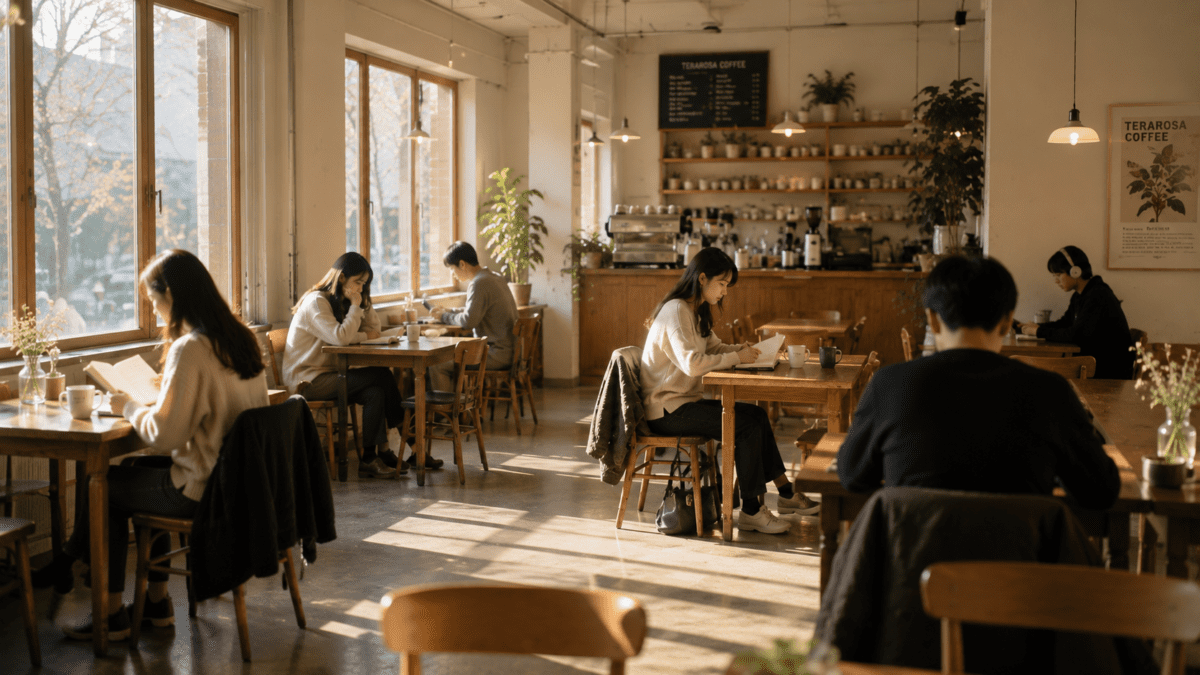
Listen to a Seoul café on a weekday morning and the sounds arrive in layers.
The espresso machine first — sharp, brief, the pressure releasing in a hiss that cuts through everything else and then stops. Underneath it, conversation at a low frequency, the particular murmur of people talking about something that does not concern you. A chair shifting. The soft percussion of a cup set down on a wooden table.
And then, if you are close enough: the sound of a page turning.
It is almost nothing. A whisper of paper, one sheet lifting and settling against the next. In a louder environment it disappears entirely. In a café at the right hour — mid-morning, when the rush has passed and the afternoon crowd has not arrived — it surfaces. You hear it from the table beside you and something in the room changes slightly. Someone is writing. The notebook is being used.
There is a woman two tables away who has been here since the café opened. Her notebook is half full. She writes a line, reads it back, writes another. The pen makes a sound so small it should not be audible. In the particular quiet of this hour it is. It lands on the ear the way a single note lands in a room after the music has stopped — noticed not because it is loud but because the silence around it makes it visible.
In Korean café notebook culture, these small sounds are part of the experience of being in the space. The scratch of a pen moving across paper. The soft thud of a notebook closing. The particular silence of someone reading back what they have just written before continuing. These sounds do not disturb. They compose. They tell you what kind of place you are in and what kind of attention is available here.
A café where people are writing feels different from a café where people are only talking. The air is different. The pace is different. Something about the presence of open notebooks changes the register of the whole room — slows it slightly, deepens it, makes it feel like a place where something is being made.
Some Thoughts Need a Different Room
There are things that do not get written at home.
Not because home is the wrong place, exactly. Because some thoughts require a different context to surface. The thought that has been circling for three days without landing. The decision that feels impossible in the familiar chair but somehow resolves itself at a café table two kilometers away. The paragraph that would not come in the apartment and arrives, fully formed, before the coffee is half finished.
This is what Korean café notebook culture understands about the relationship between space and thought: where you are changes what you can access. The same mind in a different room produces different material. Not better, not worse — different. More of some things. Less of others.
The café offers distance. Distance from the apartment, from the routine, from the particular mental furniture of the space where you spend most of your hours. Sit somewhere new and the mind loosens slightly. The associations that cluster around your usual desk do not follow you here. The thought that felt stuck becomes unstuck — not because you tried harder but because you moved.
In K-Saju, this idea has a structural equivalent. The twelve earthly branches describe time not as a neutral container but as a sequence of conditions — each station creating a different kind of availability, a different quality of what can be accessed or released. The café operates on a similar logic. It is not just a location. It is a condition. And certain thoughts only become available inside it.
Outside, the street is loud with the particular noise of a Seoul afternoon. Inside the café, a woman closes her notebook, finishes her coffee, and sits for a moment looking at the cover. She came here with something unresolved. She is leaving with it written down.
That is the thing about a café table. It is not a desk. But sometimes it works better than one.
This post was planned and edited by a human, with AI assistance.