
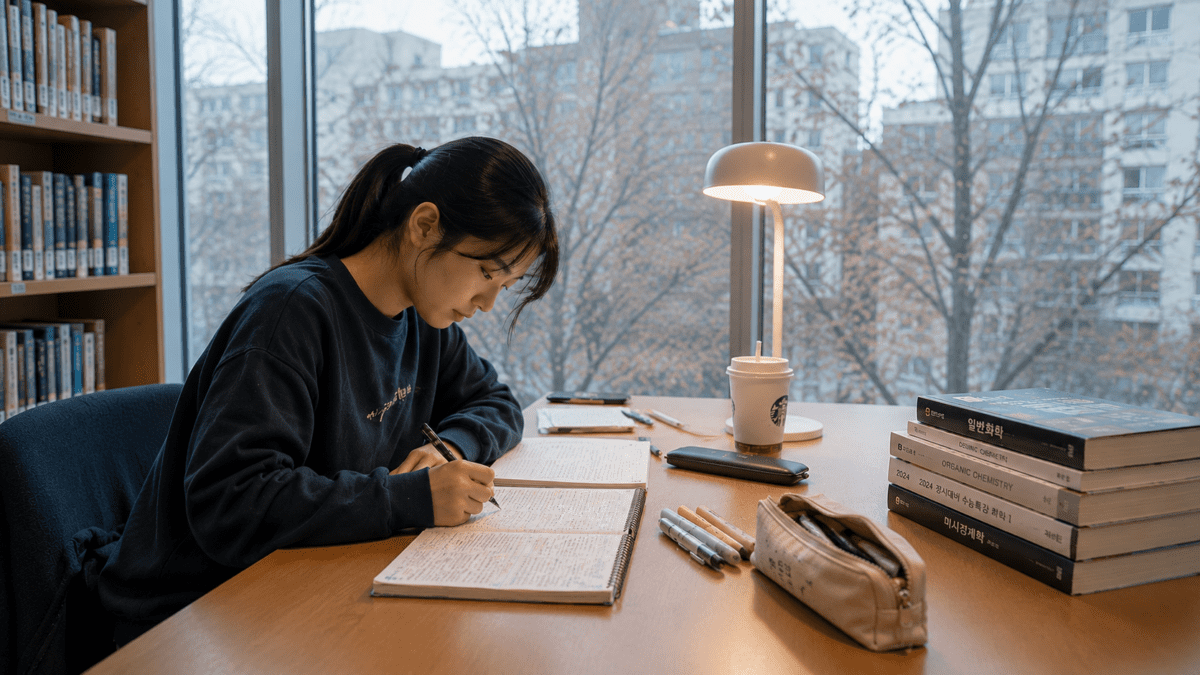
The notebook on the desk is not the first one.
There is another one underneath it — spiral-bound, pages soft from use, margins crowded with arrows and crossed-out lines. Korean study habits work this way: the first notebook was written during class, the second one afterward. Same content. Different purpose. The first one captured. The second one understood.
Not because the first version was wrong. Because writing it again is how it becomes hers.
The First Version Doesn’t Count
In a library in Seoul on a weekday afternoon, a university student opens her class notebook and places a blank one beside it. She uncaps her pen and begins copying. Not word for word — she is rewriting, restructuring, finding the logic that the lecture did not make obvious. She pauses every few lines to think. Then continues.
She has been doing this since high school. So has most of the table around her.
Korean study habits built around rewriting are not a technique picked up from a productivity book. They are something closer to a shared understanding — that the first time you write something, you are taking notes. The second time, you are learning. The difference between the two is not the content. It is what happens in the hand and the mind during the act of writing.
The first version is always a draft. A rough sketch of something not yet understood. It captures the words before the meaning has settled. Most study systems treat this draft as the finished product. In Korean notebook culture, it is just the beginning.
This is why the desk of a serious Korean student often looks the way it does — two notebooks open side by side, the original on the left, the rewrite on the right, a pen moving between them. The setup looks like copying. It is not copying. It is translation. The first notebook holds what the teacher said. The second holds what the student understood. The distance between the two is where the actual studying happens.
Learning Through Repetition

There is a word in Korean — 복습 (bokseup) — that means review, but carries more weight than the English translation suggests. It implies return. The idea that you go back to something not to check it but to deepen it. That the second encounter with material is not repetition for its own sake but a different kind of engagement entirely.
Rewriting is bokseup made physical. You return to the content with your hand, which means you return to it slowly, which means you cannot skim. Every line must be processed before it can be written. The eye cannot move ahead of the pen.
This slowness is the point. Speed-reading a chapter gives you a summary. Writing it out gives you something else — the structure, the connections, the places where the logic holds and the places where it quietly breaks down. You find the gaps not by looking for them but by trying to write past them and discovering you cannot.
A student who rewrites her chemistry notes does not do it because she enjoys writing. She does it because at the third line of the second rewrite, she realizes she does not actually understand why one element bonds with another. She understood the words. She did not understand the mechanism. The rewriting found the difference.
This is what Korean study habits have preserved that faster methods lose: the knowledge that confusion surfaces in the hand before it surfaces in the mind.
When Notes Become Memory
There is a particular smell to a well-used study notebook — ink, paper, the faint trace of the hours spent inside it. Pick one up months after the exam and the content comes back not just as information but as experience. The cramped section near the back where time was running short. The page where the handwriting loosens because something finally clicked. The margin note that made no sense at the time and makes perfect sense now.
This is how Korean study habits turn memory into something that lives in the body as much as the mind.
In a small apartment in Seoul, a student pulls an old notebook from the shelf above her desk. It is from two years ago — the cover worn at the corners, the spine slightly cracked from being opened too many times. She flips to the middle and stops. The handwriting on this page is different from the pages before it. Slower. More deliberate. She remembers the night she wrote it. She remembers the exact moment the concept stopped being words and became something she could see. The notebook did not just record that moment. It is the reason the moment happened.
Research on handwriting and encoding has documented what students who rewrite their notes already know: writing by hand creates a different kind of retention than typing.
In Korean notebook culture, this is not a research finding. It is common knowledge passed from older students to younger ones, from parents who studied the same way to children who are learning it now. You rewrite because it works. The mechanism matters less than the result: the student who rewrites her notes for an exam in two weeks will remember more than the one who reads them three times.
The notebook becomes memory not when it is finished but when it has been returned to enough times that the handwriting itself is familiar. When you know which page a concept lives on before you open to it. When the physical experience of writing something the third time tells you, without having to check, that you have finally understood it.
Some students keep their old study notebooks for years. Not for the content — most of it becomes irrelevant after the exam. For the record of the process. The proof that understanding was reached, and the trace of exactly how it happened. Open one five years later and the handwriting alone tells a story the words never intended to tell.
Why Writing Slows Understanding Down

Speed is not the enemy of learning. But the Korean study habits that survive long enough to matter are built around a different premise: speed is not the friend of understanding.
There is a difference between the two that Korean study habits navigate carefully. Learning is accumulation — facts, dates, definitions, formulas. Understanding is something else. It is the moment when the accumulated facts reorganize themselves into a structure that makes sense. When you stop memorizing and start seeing.
Writing slows the process down to the speed at which understanding can actually happen.
Type a sentence and the fingers keep pace with the thought, sometimes ahead of it. The words appear before they have been fully considered. Write the same sentence by hand and something different occurs — the pace forces a kind of deliberateness. Each word is a small decision. Each line is a commitment. The thought cannot outrun the pen, so it has to wait, and in waiting it sometimes clarifies.
A student sitting with her rewritten notes the night before an exam is not studying harder than the one reading from a laptop. She is studying differently. The material has passed through her hand three times. Each pass left something behind — a correction, a connection, a question in the margin that she later answered. The exam will ask her to retrieve information. What she will retrieve is not just the information but the experience of having written it.
Outside the library, the evening light is the particular grey of a Seoul autumn. Inside, the table has not emptied. New students have taken the seats of the ones who left. The notebooks are different. The method is the same.
First version on the left. Second version on the right. Pen moving slowly across the page.
Understanding lives in the distance between the two.
This post was planned and edited by a human, with AI assistance.