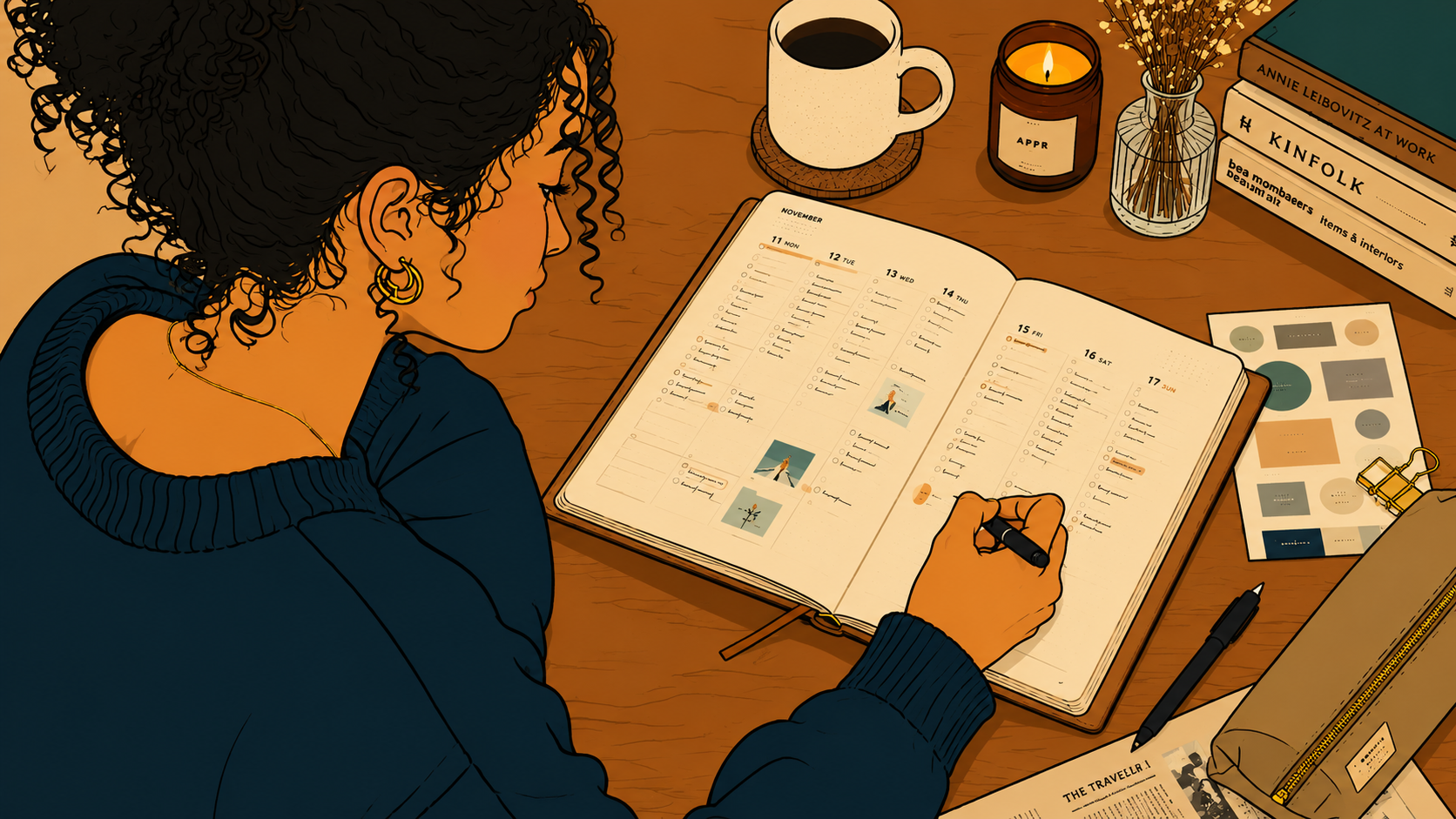
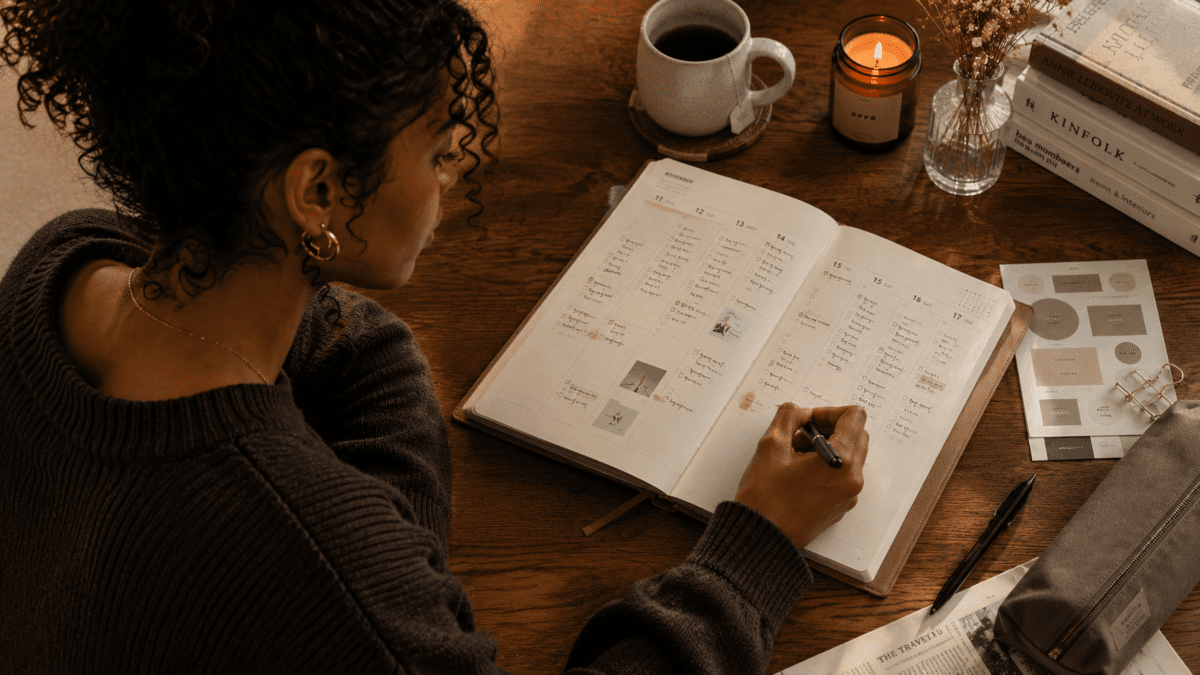
The display table near the entrance changes in November. Summer notebooks move to the back wall. Planners take the front — thick ones, slim ones, weekly layouts, hourly grids, undated covers in muted green and sand and rust. A woman picks one up, flips to March, runs a finger along the weekly spread. She puts it down. Picks up another.
She is not buying a calendar. She already has one on her phone. She is buying something the phone cannot give her.
The Korean planner year does not begin in January. It begins here, in November, when the new year is still weeks away and the decision about how to hold the next twelve months is already being made.
The Year Starts Before January

Walk past any large bookstore or stationery chain in Seoul between October and December and the planner wall is impossible to miss. Hobonichi Techos sell out before Christmas. Midori MD planners move faster than notebooks. Korean brands like Motemote and After the Rain release limited editions that disappear within days.
This is not impulse buying. People return to the same brand year after year, sometimes for a decade. They know the paper weight. They know whether they prefer a Monday start or a Sunday start. They have opinions about whether monthly spreads should face each other or sit on separate pages.
The ritual of choosing the next planner is itself a form of planning. You hold it and imagine the year inside it — the weeks that will fill up, the months that will feel long, the page in August where something important might land. The planner is empty and already full of possibility.
There is a particular kind of attention that happens in a stationery store in November. Two women stand side by side at the planner wall, each holding a different brand, neither speaking. One opens to the weekly spread. The other checks the thickness of the paper by folding a corner back, gently, the way you test fabric before buying it. They have both been here before. They will both be back next year.
This is the part of Korean planner culture that does not translate easily into a description of habits or trends. It is a yearly appointment that people keep without being asked. November arrives and the question surfaces on its own: what kind of year do I want to hold?
In Korea’s planner tradition, the new year does not arrive on January 1st. It arrives the moment you write your name inside the cover.
The Comfort of Seeing Time
Open a weekly spread and time becomes something you can look at.
Monday through Sunday, laid out flat. Each day a column, each hour a line. The week is no longer abstract — it has shape, weight, proportion. Tuesday is visibly shorter than Thursday. The gap between two meetings is three centimeters of white space. The weekend is right there, two columns on the right, already waiting.
This is what the Korean planner understands about time that digital calendars do not: seeing is different from knowing. There is a rhythm to time that most systems never show you — the clock nobody showed you runs deeper than any weekly spread, but the planner is where you first learn to feel it. You can know your schedule. Seeing it is a different experience. The eye reads space. It reads density. It reads the week before you have lived it and tells you something the app notification cannot.
A digital calendar delivers information on demand. You tap, it opens, it shows you what is next. The planner shows you everything at once — the whole week, the whole month, the shape of the next three months in a single glance. There is no loading. No tap. Just the page, open in front of you, giving you the picture before you ask for it.
People who keep planners often describe the same sensation: opening the weekly spread in the morning and knowing, before reading a single word, whether the week ahead feels heavy or light. The density of the handwriting reveals it. The amount of white space reveals it too. The body reads the page before the mind does.
The Blank Space Problem
A blank page in a notebook is an invitation. A blank day in a planner is something else.
In Korean planner culture, empty space carries a particular discomfort — not because busyness is valued above rest, but because the planner is not just a schedule. It is a record. A blank Wednesday means Wednesday passed without being held. Something happened, or nothing happened, and either way it is gone without a trace.
This is not anxiety. It is attention. The planner asks you to notice your own days. To mark them. To give them at least a line, a small entry, something that says: I was here. This was the weather. This was what I ate for lunch. This was the thought I had on the subway that I did not want to lose. On the train home, a university student adds one sentence beside an already crowded date box. Nothing important happened. The act of writing it down is what made the day visible.
Some people fill their planners with tasks and appointments. Others fill them with observations — the first cold morning of autumn, the café they found by accident, the sentence from a book that stopped them mid-page. Both are using the planner correctly. The point is not what goes in. The point is that something does.
Leave too many blank days and the planner becomes a record of absence. That is the discomfort. Not failure, exactly. More like a week that slipped through without being caught.
The solution is not to fill every hour. It is to pay enough attention that something always finds its way onto the page.
Planning as a Daily Ritual

She opens the planner before she opens her phone.
This is the sequence that many people who keep planners in Korea describe without thinking much about it — as if the order were obvious, the way you put on shoes before going outside. Planner first. Phone after.
The morning entry takes five minutes, sometimes three. The date at the top. Two or three things that need to happen. One thing she wants to remember from yesterday. The pen goes back in the loop on the cover. The planner closes. The day can begin.
This is what the Korean planner has understood that productivity systems often miss: the ritual matters as much as the content. The act of opening the planner, writing the date, and committing three things to paper is not just planning. It is orientation. It is the small ceremony that separates the night from the day and tells the mind: we are starting now.
Digital systems can replicate the content of this ritual. They cannot replicate the sensation of it — the particular weight of the pen, the slight resistance of the paper, the finality of ink that cannot be deleted. When something is written by hand, it carries a sense of commitment that a typed task list does not. The hand knows this even when the mind argues otherwise.
Some people have kept the same planner format for seven or eight years. The brand changes occasionally. The layout stays the same. There is something in the consistency that is not habit exactly — more like a relationship with a particular way of seeing time. Change the layout and the year feels different. Keep it and the muscle memory of twelve months fits inside your hands before the first week begins.
The planner does not need to be elaborate. The most useful ones rarely are. A slim weekly layout, a consistent pen, the same five minutes every morning. Over weeks this becomes a rhythm. Over months it becomes a relationship with time that feels, in some way that is difficult to explain, like knowing where you are.
Outside the stationery store, the November air has the particular sharpness that arrives before the first cold week. A woman walks out with a paper bag, the spine of a new planner just visible at the top. She pauses on the pavement, opens it to the first week of January, and writes something small in the corner.
The first week of January is still empty. Her handwriting is already there.
This post was planned and edited by a human, with AI assistance.