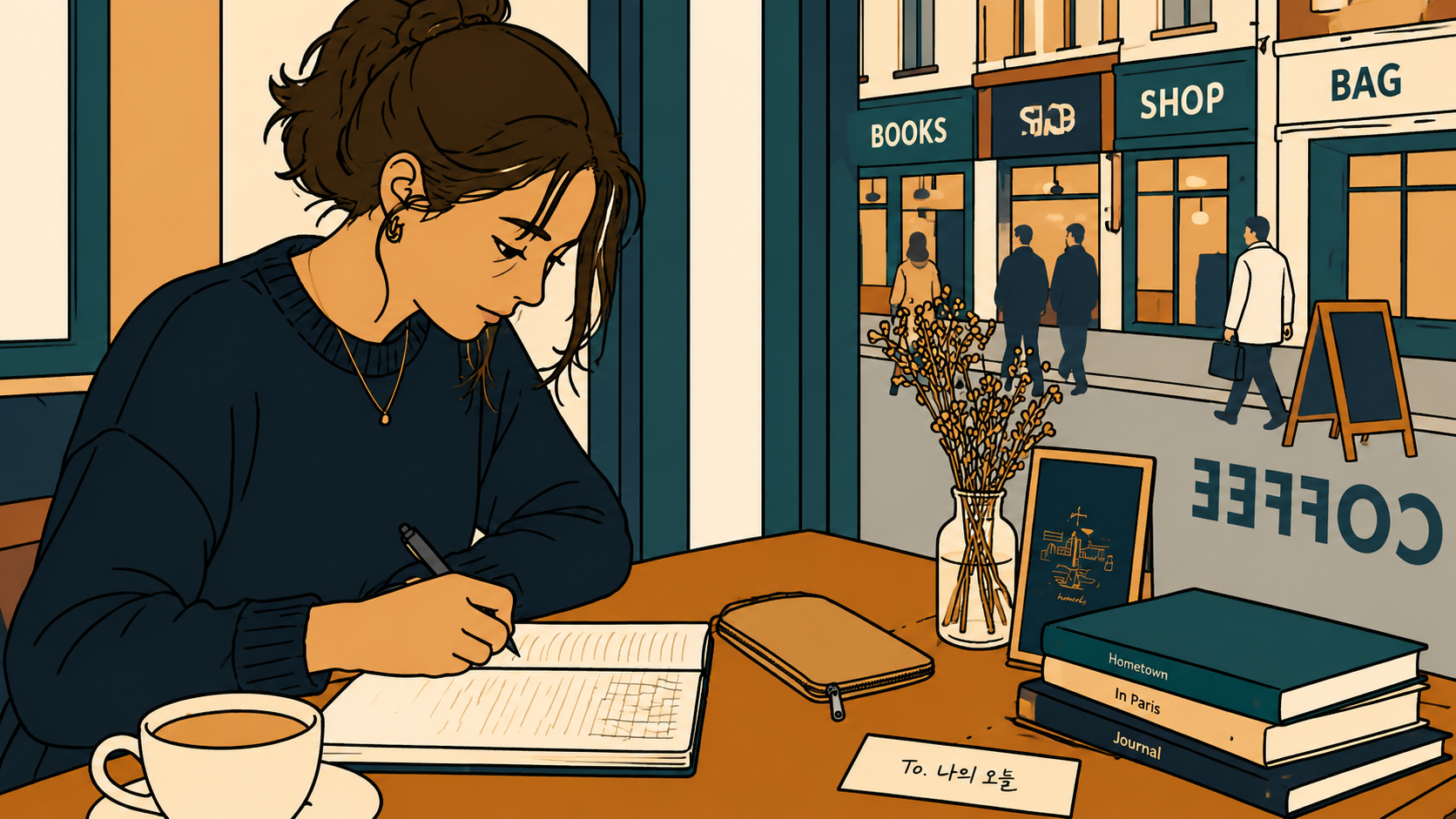

She has been sitting at the corner table for an hour. Coffee finished, phone face-down on the wood, pen moving slowly across the open page. The notebook is small — cream paper, a few ink smudges near the spine. She is not writing a list. She is not drafting anything. She writes a line, stops, looks out the window, writes again.
Nobody around her finds this strange. In the café, two other people have notebooks open. One is sketching. The other is filling a grid page with small, careful handwriting.
This is Korean journaling. Not a trend. Not a revival. Just something that never stopped.
The Notebook That Refuses to Disappear

Walk into a stationery store in Seoul on a Saturday afternoon — a Kyobo Hottracks packed with students, office workers, and people who came for just one notebook. Hear the soft thud of covers being lifted and set down, the sound of pages fanned with a thumb, the faint smell of paper and ink that sits in the air without asking for attention.
The walls are full. Grid notebooks, dot notebooks, lined notebooks, blank ones. Covers in kraft paper, linen, soft leather worn at the corners. Sizes small enough for a coat pocket, large enough to spread across a café table.
The woman at the counter is not buying office supplies. She is twenty-four, maybe twenty-six, and she has been here before. She holds a notebook with both hands before deciding. She knows what she wants, but she wants to feel it first.
Every few years, someone announces that paper is finished. Smartphones arrived and the notebook was supposed to go. Then apps. Then cloud storage. Then voice notes. Each time, the prediction made sense. Each time, the notebooks stayed.
Korean journaling did not survive out of stubbornness. It survived because it does something that none of the replacements could.
Writing Before You Know What You Think
The phone is good at capturing things you already know.
You open a note app when the thought is formed. You type fast, close the app, move on. The phone receives what you give it. It does not help you find what you haven’t found yet.
The notebook works differently. You pick up the pen without knowing what comes next. The hand moves slowly across the page — slowly enough that something has time to arrive. Halfway through a sentence, you discover what you meant to say. The writing is not recording the thought. The writing is the thought.
In Korean journaling, this is understood without being explained. You see it in the way people carry their notebooks — not in a bag pocket, but in a hand, or tucked under an arm. Close. Accessible. The way you carry something you actually use.
There is no autocomplete. No notification arriving sideways. No suggested word finishing your sentence before you have decided how it ends. Just the pen, the particular weight of it, and the page waiting.
A lot of what gets written never gets read again. That is not the point. What accumulates beneath the surface — the slow, invisible layering of thought on thought — always is. The kind of depth that builds without announcing itself, until the conditions are right for it to move.
A Place for Unfinished Thoughts
The phone demands completion.
A note app wants a title. A task manager wants a deadline. A calendar wants a start time and an end time. Every digital tool asks you to categorize the thought before you have understood it — to name it, file it, close it.
The notebook has no such requirements. A half-sentence sits next to a small drawing sits next to three words that seemed important at the time. Nothing needs to be organized. Nothing needs to make sense yet. The page holds it without asking what it is.
This is what Korean journaling understands about the act of writing — that some thoughts are not ready. That they need to be held somewhere visible, somewhere returnable, until the moment they click into place. You come back three days later, read a line you had forgotten, and something shifts. The notebook kept it warm.
There is a kind of patience in this that productivity culture does not reward. The planner, the app, the optimized system — all of them push toward resolution. The notebook pushes toward nothing. It just holds. And sometimes, what gets held long enough becomes the clearest thing you have ever written.
This is not a romantic idea about paper. It is something you notice after years of keeping notebooks — that the half-finished thought you abandoned on a Tuesday in March turned out to be the most important thing you wrote that year. You did not finish it then because you were not ready. The notebook did not delete it because it had no reason to.
After years of keeping notebooks, many people notice the same thing. The notebook is one of the few tools that asks for nothing. It doesn’t organize, optimize, or remind. It simply waits.
Run a finger across a page you filled two months ago. Feel the slight ridge where the pen pressed harder on a word that mattered. That pressure is information no phone can store.
What Paper Still Does Better
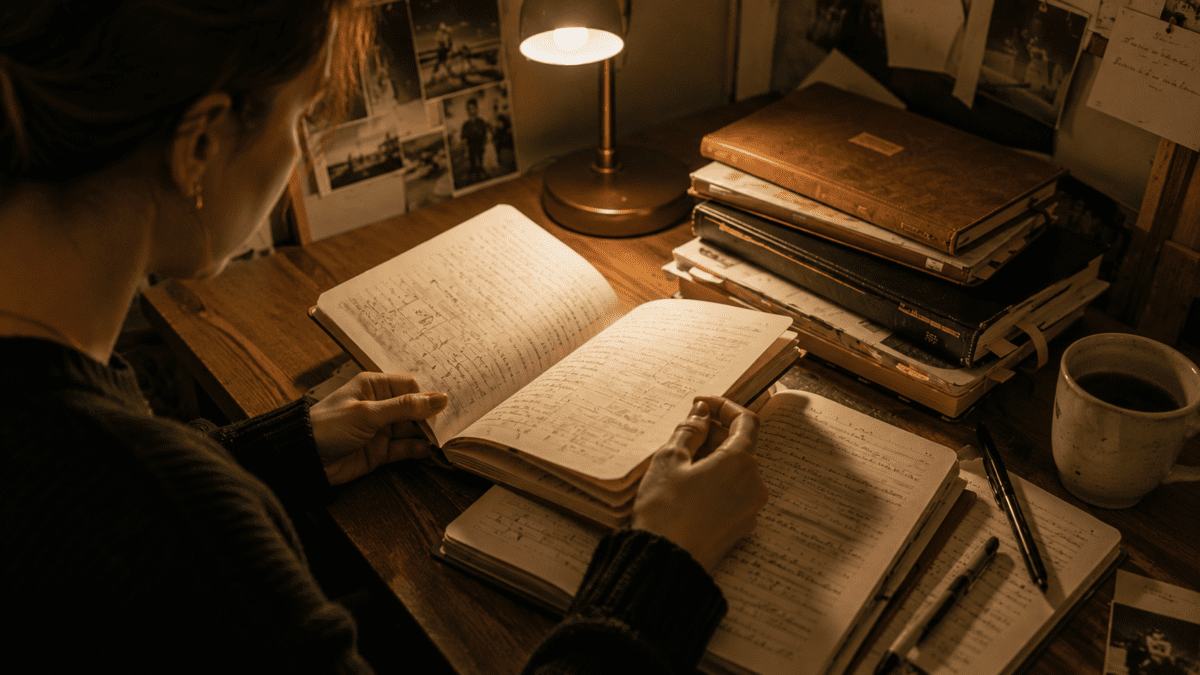
There is a texture to writing by hand that the body remembers.
The slight resistance of good paper against the nib. The way ink sits differently on cream stock than on white. The sound — small, soft, almost nothing — of the pen moving across the page. These details are not decorative. They are part of why Korean notebook culture holds the attention of people who could easily use something faster.
Writing by hand is slow. That is the feature, not the flaw. The slower pace means the mind stays present in a way typing does not require. There is nothing to scroll. Nowhere to go. The page is the only place.
People who write by hand remember more of what they wrote — not because handwriting is magical, but because the act of forming each letter is itself a form of processing. Research on handwriting and memory has documented this consistently for over a decade. The thought passes through the body before it becomes permanent. Something about that passage makes it stick.
The notebooks stacked on the shelf above a desk. The one that lives in the bag, soft-cornered and slightly curved from months of being carried. The one kept on the nightstand for the thought that arrives just before sleep. Each one holds a different kind of attention.
Korean journaling is not one thing. It is the planner filled before January. The study notebook rewritten three times before the exam. The café notebook opened when the apartment feels too quiet. The small one pulled out on the subway, held with one hand, written in with the other.
What they share is this: the decision to think on paper. To slow down enough to find out what is actually there.
In a Korean café, this does not look dramatic. It looks like someone turning one page, checking the date at the top, and writing three plain sentences before the coffee gets cold. Nothing announces itself. But something has been moved out of the mind and placed where it can finally be seen.
Outside the stationery store, the afternoon light is changing. A woman walks out holding a paper bag, one corner of a cream notebook visible at the top. She does not look at her phone. She turns left and disappears into the street, and the bag swings lightly at her side.
The pen is still the best tool for that.
Nobody has built anything better yet.
This post was planned and edited by a human, with AI assistance.